
The right stock of one-piece fittings for farm equipment comes from the local machine population, not a generic list of popular hydraulic ends. Tractors, harvesters, sprayers, balers, loaders, and implements may have different origins, hose systems, ports, and routing constraints, so apparently broad inventory can still miss the combinations used in real repairs. A useful plan connects verified machine positions to connection standard, port dash, hose dash, fitting series, configuration, and current crimp data.
Build the Inventory Around the Local Equipment Population
Farm-fitting demand varies because a service area rarely contains one uniform equipment platform. The installed fleet should be treated as a set of identifiable hydraulic applications rather than a single agricultural market.

Record brands, origins, models, and working roles
Start with the equipment that is active locally, including its brand, model family, country or market of origin, age, and hydraulic work. A tractor used mainly for transport creates different service exposure from a loader tractor that cycles cylinders throughout the day. Harvesters add dense routing and time-critical seasonal systems; sprayers add booms, folding circuits, and frequent movement; balers introduce repetitive implement connections; loaders place hoses near articulation and attachment interfaces. These differences shape demand more reliably than catalog popularity.
Equipment origin matters because the machine, replacement component, and later attachment may not share the same connection system. A locally sold tractor may carry an imported loader, a replacement valve from another market, or hoses assembled during earlier repairs. Record what is physically verified at the service position instead of assigning a standard from the nameplate alone. The resulting population map should show recurring hydraulic positions and the evidence behind each fitting identity.
Map implements separately from their power units
Implements deserve their own records because they move between tractors and may introduce ports, adapters, hose sizes, and orientations not found on the power unit. A sprayer, baler, mower, seeder, front loader, or other implement can create demand at the tractor interface, on-board valve block, cylinder, motor, or moving hose route. Treating all of those positions as “tractor fittings” hides the source of demand and encourages incorrect consolidation.
For each important implement, record the connection at both ends of the hose, the hose identity, and the installation geometry. Also note whether the implement is locally common, shared across farms, or serviced only occasionally. A rarely seen implement with a long replenishment lead time may justify backup coverage, while an unverified connection should remain a special-order item until its identity is confirmed.
Connection Systems Define Separate Stock Families
JIC, ORB, NPT, BSP, and Metric connections can coexist in agricultural fleets, but they are not one interchangeable family. Stock records must preserve the thread and sealing characteristics that determine whether a fitting actually connects and seals.
Separate thread identity from sealing method
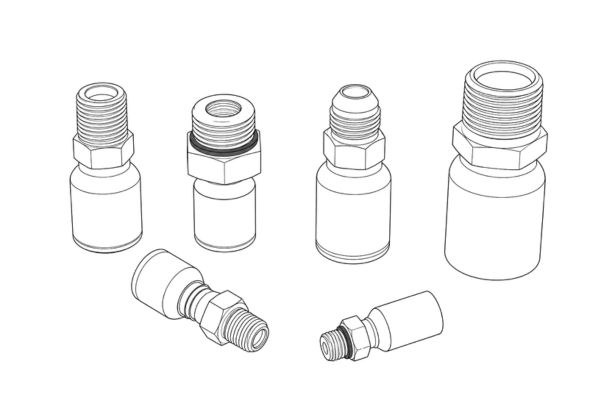
JIC connections use a flare-seat sealing arrangement, while ORB connections rely on an O-ring at a straight-thread port. NPT is a tapered pipe-thread system, and BSP may refer to straight or tapered variants with different sealing arrangements. Metric is also not a complete identification by itself because metric connections can use different thread forms, seats, sealing faces, and standards. These category names narrow the search, but final identification still requires the relevant diameter, pitch or TPI, straight or tapered form, gender, seat, sealing face, and O-ring location.
Do not infer a connection standard only from the equipment brand or its country of origin. Imported equipment and attachments often introduce BSP or Metric connections into a fleet that also uses JIC, ORB, or NPT, while prior component replacement may create another variation. A photo can help sort candidates, but it cannot confirm the final SKU. Measurements and verified technical references should control the stock record.
Prevent false consolidation across similar-looking ends
Warehouse descriptions should distinguish the port connection from the hose-end series. A label such as “male elbow” is incomplete because it omits the connection family, nominal designation, sealing method, port dash, hose dash, and fitting-series identity. Combining visually similar ends in one bin turns nominal inventory into uncertain inventory and increases the chance of thread damage or leakage during a rushed repair.
Use separate, searchable attributes for:
- connection standard, gender, thread form, and sealing method;
- verified port dash and hose dash;
- straight, 45-degree, or 90-degree configuration and orientation;
- fitting series, hose series, material, finish, and controlled crimp reference;
- machine or implement positions that support the stocking decision.
Port Dash, Hose Dash, and Configuration Form the Usable SKU
A connection that fits the machine port is only half of the selection. The hose side and physical configuration must also match the assembly data and installation envelope.
Keep port dash and hose dash independent
Port dash describes the connection side, while hose dash identifies the nominal hose size used by the fitting tail. They may be the same on some fittings and different on others, so copying one value into both fields creates false matches. The hose dash also does not prove hose compatibility: hose manufacturer, series, construction, reinforcement, fitting series, stem geometry, ferrule design, and current crimp specification still govern the approved combination.
Build the inventory matrix from verified port-dash and hose-dash pairs found at real service positions. Review how often each pair appears, which hose series the workshop actually carries, and whether the applicable fitting series is supported by the available crimp equipment. A fitting that matches a port but cannot be assembled to the local hose system should not count as usable stock.
Treat straight, 45-degree, and 90-degree ends as different needs
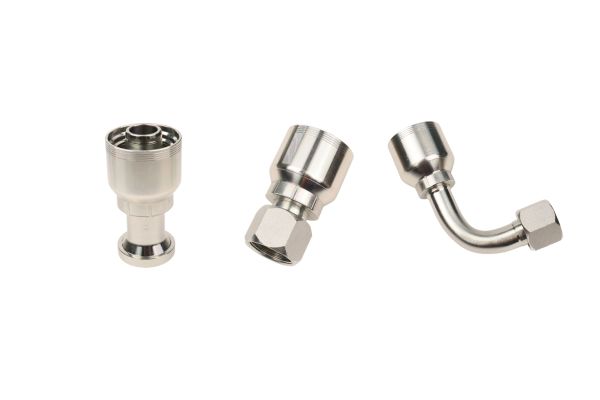
Straight, 45-degree, and 90-degree configurations solve different routing and clearance problems. An elbow may keep a hose away from a tire, frame edge, articulation point, cab structure, or moving linkage, while a straight fitting may be correct where the hose can leave the port without an immediate bend. Replacing an elbow with a straight fitting can force the hose below its permitted bend radius, create side loading near the ferrule, or cause abrasion during machine movement.
Angle alone is not enough for an elbow record. Capture the orientation of the hose tail relative to the connection, any swivel feature, critical clearance, and the direction of movement. On formed hoses with two angled ends, relative orientation may affect whether the assembly can be installed without twist. Stock coverage therefore needs verified geometry, not simply a count of straight and elbow pieces.
Local Hose and Crimp Capability Set the Practical Boundary
One-piece construction can reduce separate ferrule picking, but it does not make every stocked fitting compatible with every hose. Practical inventory ends where verified hose and crimp capability ends.
Link fittings to the hose series actually in service
Identify the hose manufacturers, hose series, constructions, and dash sizes used in local repairs and on the active fleet. Similar-looking hoses or equal dash sizes may use different reinforcement, cover thickness, outside diameter, and approved fitting systems. If the workshop carries several hose families, each fitting record should state which exact combination is supported rather than relying on a broad “fits hydraulic hose” description.
The applicable hose, fitting, and crimp-equipment manufacturers’ current data should define skive or no-skive preparation, insertion, die selection, crimp dimensions, and inspection. Do not create stock merely because the fitting can be physically inserted into a hose. Components without controlled assembly data belong in quarantine or special-order review, not in the usable core.
Use repair history as technical evidence
Repair history should record more than a part number and quantity. Useful evidence includes the machine and position, connection and seal, port dash, hose dash, hose and fitting series, configuration, crimp procedure reference, failure mode, and whether the replacement was verified. This information distinguishes genuine repeat demand from a one-time accident, incorrect earlier replacement, or damage caused by routing rather than fitting availability.
A quarterly or seasonal review can then compare issued stock with confirmed repairs. Investigate repeated use at the same position: it may justify inventory, but it may also indicate abrasion, excessive movement, heat, contamination, or installation stress. Stock planning should improve availability without treating recurring failure as normal.
Seasonality Changes Timing, Not Technical Requirements
Agricultural demand often concentrates around planting, spraying, harvest, and scheduled maintenance windows. Seasonality should change when inventory is reviewed and replenished, not lower the standard for fitting identification or assembly.
Prepare before peak operating periods
Before a local peak season, review the machines and implements expected to work, unresolved repairs, verified consumption history, supplier lead times, and the condition of existing stock. Planned inspection may reveal worn hoses or damaged fittings that can be replaced before field work begins. This moves predictable demand into planned maintenance and leaves core stock available for unplanned failures.
Useful pre-season actions include:
- reconcile bin labels with verified fitting identities and remove mixed or unidentified items;
- confirm that stocked fitting series still match the hose series and current crimp procedures in use;
- review open orders, lead times, and critical machine positions with no supported alternative;
- inspect storage condition, corrosion, thread protection, ferrule damage, and traceability;
- update machine and implement records after additions, disposals, or major component changes.
Weigh equipment criticality without copying emergency-stock logic
Criticality helps decide whether an infrequent verified item belongs in backup stock, but farm inventory planning also considers the breadth and stability of the local fleet. A harvester unavailable during its operating window may justify stronger coverage than a nonessential implement with accessible alternatives. However, criticality never authorizes a near-match, an unverified hose combination, or improvised crimp settings.
Before examining a failed assembly, stop and isolate the equipment, release hydraulic pressure and stored energy, secure raised or suspended loads, and follow lockout and manufacturer procedures. Never search for a pinhole leak by hand or remove a fitting under pressure. Safe inspection preserves both people and the evidence needed for correct identification.
Classify Core, Backup, and Special-Order Items
Stock classes should express evidence and response strategy rather than fixed quantities. The same fitting may belong to different classes in different service areas because machine population, repair frequency, lead time, and assembly capability differ.
Apply a repeatable classification method
| Stock class | Evidence required | Management rule |
| Core Stock | Repeated verified use across active machines or implements; supported hose and crimp system | Review usage, replenishment, labeling, and condition routinely |
| Backup Stock | Infrequent but verified need tied to important equipment, difficult lead time, or limited alternative | Preserve traceability and reassess criticality and supply exposure before each season |
| Special-Order Items | Rare, uncertain, model-specific, obsolete, or unsupported combinations | Confirm complete technical identity and application before ordering |
Classification should consider both demand evidence and technical usability. Core Stock is not simply the most frequently purchased group if some purchases resulted from misidentification. Backup Stock is not a dumping ground for slow movers, and Special-Order status does not mean unimportant; it means the need is too rare, uncertain, or technically specific to justify routine availability.
Set review rules instead of universal quantities
Determine replenishment from verified issues, active equipment count, repair timing, supplier lead time, current usable inventory, and the consequence of a stockout. Do not prescribe a universal SKU count, minimum, or reorder quantity. A smaller controlled inventory can serve the fleet better than a larger collection of unverified combinations.
Keep obsolete, damaged, mixed, or unidentified fittings outside available inventory until they are resolved. Review whether discontinued machines, new attachments, hose-system changes, or a different crimper have altered the basis for each class. This prevents old assumptions from remaining embedded in the stock plan.
Correct Common Stock Errors and Record the Final Decision
Most agricultural fitting-stock errors begin with incomplete identity or weak demand evidence. A final checklist should connect each SKU to a real application and a supported assembly process.
Watch for misleading shortcuts
Common mistakes include assuming all local machines use one connection standard, treating a brand as proof of thread type, copying port dash into hose dash, and counting straight fittings as substitutes for elbows. Other failures come from mixing fitting series, retaining untraceable stock, or buying around a single unusual repair. These shortcuts inflate inventory while leaving actual repair positions uncovered.
Before assigning a stock class, confirm:
- active machine or implement, model family, origin, hydraulic position, and operating season;
- connection standard, gender, thread features, seal, port dash, and verified reference;
- hose manufacturer, series, construction, hose dash, fitting series, and ferrule design;
- straight, 45-degree, or 90-degree geometry, orientation, clearance, and routing;
- available crimper, die set, current crimp data, and inspection method;
- repair frequency, equipment criticality, replenishment lead time, and evidence for the class.
Conclusion
Effective agricultural fitting inventory starts with the machines and implements that actually operate in the service area. Map tractors, harvesters, sprayers, balers, loaders, and attachments by origin, hydraulic position, connection system, port dash, hose dash, and geometry. Then limit usable coverage to combinations supported by the local hose series, fitting series, crimp equipment, and current assembly data. Repair history and seasonal workload determine when to review stock, while equipment criticality and lead time help separate Core Stock, Backup Stock, and Special-Order Items. Keep uncertain fittings out of available bins and never substitute by appearance during field work. This evidence-based method makes one-piece fittings for farm equipment easier to find without creating a universal or wasteful SKU list.
Frequently Asked Questions
Should a fitting used on several tractor brands automatically become Core Stock?
No, repeated brand coverage alone is not sufficient. Confirm that the connection, hose combination, fitting series, configuration, and crimp process are genuinely the same at each recorded position.
How should fittings for an implement shared by several farms be classified?
Classify them from verified usage, equipment criticality, lead time, and supported assembly capability. Shared use may strengthen the evidence for coverage, but it does not remove the need to confirm each connection and hose side.
Can adapters reduce the number of agricultural hose fittings kept in stock?
Sometimes, but only when the adapter, port, fitting, routing, and complete assembly are approved for the application. An adapter may add joints, length, and clearance demands, so it should not be assumed to be a universal substitute.
Should old fittings removed from machines be used as inventory samples?
They can support preliminary identification, but they should not be the only authority. Wear, damage, prior modification, and an incorrect earlier repair can make an old part misleading, so measurements and verified references remain necessary.
How often should the farm-equipment stock classification be reviewed?
Review it when the fleet, implements, hose system, crimp equipment, repair pattern, or supplier lead time changes, and before important seasonal work. A fixed calendar alone cannot capture every local change.