
One-piece fitting hose compatibility requires more than matching the dash size printed on a bin label. Before crimping, confirm the exact hose, its construction and size, the fitting series, the connection end, the applicable crimp specification, and the operating conditions of the finished assembly. Missing any one of these checks can produce a hose that is difficult to assemble, fails inspection, leaks, pulls off, damages the hose, or cannot safely support the intended service.

Define Compatibility Before Selecting a Fitting
One-piece describes construction, not universal fit
A one-piece hydraulic hose fitting normally combines or preassembles the fitting body or stem with its ferrule as one assembly component, although the exact retention method varies by product series. This construction simplifies handling and removes the separate task of selecting a loose ferrule, which can reduce picking errors in a shop that stocks several stem and shell families.
Compatibility has a hose side and a connection side
The hose side determines whether the stem and ferrule can retain and seal the specified hose after crimping, while the connection side determines whether the finished assembly can mate and seal with the equipment port, tube end, or adapter. These are separate decisions. A correct JIC, ORFS, NPT/NPTF, BSPP/BSPT, Metric, DIN, SAE, or JIS connection does not prove that the hose tail belongs with the hose; likewise, a correct hose-side fitting can still have the wrong thread, seat angle, or sealing face. Treating both sides as independent verification points prevents a recognizable connection end from distracting the assembler from an incompatible hose series.
Checks 1 and 2: Identify the Hose and Its Construction
Check 1: Confirm the exact hose identity
Read the complete hose layline before selecting the fitting; record the hose manufacturer, product series, applicable specification, hose ID or dash size, and any date or lot information required by the shop’ traceability procedure. If the layline is missing, damaged, painted over, or inconsistent with the job record, do not identify the hose from color, cover texture, measured outside diameter, or the old fitting alone. Different hoses can share a nominal ID while requiring different fitting families and assembly instructions. An old assembly is useful evidence, but it may contain an earlier substitution, so verify it against hose documentation rather than copying it automatically.
Check 2: Verify construction, size, and preparation
Hose construction affects how the stem and ferrule interact with the tube, reinforcement, and cover during crimping; confirm reinforcement type and layers, cover condition, wall and outside dimensions where the procedure requires them, and whether the documented assembly uses skive, no-skive, or another preparation method. Dash size is a convenient size code, not proof that two hose products have identical construction or fitting requirements. Do not remove cover material, select a skiving length, or assume a no-skive procedure without the applicable hose-and-fitting data. If the hose has visible damage, flattening, contamination, age concerns, or an uncertain layline, resolve those conditions before evaluating fitting compatibility.
Collect this hose-side evidence before moving to the fitting:
- complete hose manufacturer and series designation;
- hose ID or dash size and relevant construction details;
- readable layline and traceability information required by the shop;
- preparation method specified for the proposed fitting system; and
- the current technical source used to identify the hose.
Checks 3 and 4: Match the Fitting Series and Connection
Check 3: Match the complete fitting series
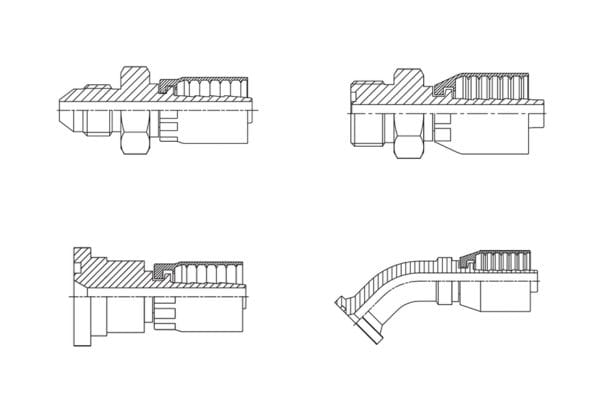
Select the fitting by complete series and part description, not by a stem that appears to enter the hose; the correct one-piece fitting must have a stem profile, insertion length, ferrule geometry, and material arrangement intended for the identified hose construction and size. Similar-looking fittings from different series may use different tooth patterns, shell lengths, collapse behavior, or crimp dimensions even when their connection ends and dash sizes match. Record the manufacturer or controlled source, fitting series, complete part number, orientation, and hose range to which the technical data applies.
Check 4: Verify thread, seat, and sealing method
Identify the connection end separately from the hose tail; confirm male or female form, thread outside or inside diameter, pitch or threads per inch, straight or tapered thread, seat angle, sealing face, and any O-ring, bonded seal, or washer required by the documented connection. Similar diameter does not establish interchangeability: JIC and SAE 45-degree seats, NPT and NPTF forms, BSPP and BSPT connections, ORFS and other face seals, and different Metric, DIN, or JIS forms require their own evidence. Photographs can narrow the possibilities but cannot replace measurement and mating-component verification.
| Compatibility point | Evidence required | Unsafe shortcut |
|---|---|---|
| Hose identity | Manufacturer, series, layline, size | Selecting by color or OD alone |
| Hose construction | Reinforcement and documented preparation | Assuming equal dash size means equal construction |
| Fitting series | Complete part number and applicable hose range | Matching only the stem appearance |
| Connection end | Thread, pitch, taper, seat, and seal | Checking only whether threads start |
| Crimp process | Current data for hose, fitting, and machine | Reusing a value from a similar assembly |
| Service suitability | Pressure, fluid, temperature, impulse, environment | Rating the assembly from the fitting alone |
Checks 5 and 6: Confirm the Crimp Process and Service
Check 5: Use valid crimp data for the exact combination
Crimp data must apply to the identified hose, fitting series, size, and crimping equipment; depending on the documented system, it may define die selection, skive or no-skive preparation, insertion depth, crimp position, final crimp diameter, and inspection method. Do not create a universal diameter, copy a setting from another brand or series, or assume that equal dash size permits the same crimp. Verify that the machine and dies are suitable and maintained under the shop’ procedure, mark insertion depth where required, and confirm full insertion before crimping.
Check 6: Confirm the finished assembly suits the service
Compatibility also depends on what the assembly will experience after installation; record working pressure, pressure impulse, fluid, temperature, ambient exposure, corrosion conditions, routing, bend requirements, movement, vibration, and applicable equipment or regulatory requirements. The usable pressure and temperature range is controlled by the lowest-rated component or interface in the hose, fitting, connection, and complete assembly, not by the fitting catalog value in isolation. Material and surface finish must suit the fluid and environment, but no material is automatically best for every application and a salt-spray result is not a direct prediction of service life. If the application is safety critical or its operating conditions are unknown, obtain the equipment and component manufacturers’ data before assembling a substitute.
Apply the Six Checks at the Assembly Bench

Use a fixed verification sequence
A repeatable order makes missing information visible before the fitting becomes permanently crimped. Start with hose identification, then construction and size; move to the fitting series, then connection geometry; finish with the crimp specification and service conditions. Record the source used for each decision rather than placing a single check mark beside compatible. If two sources conflict, quarantine the components and resolve the discrepancy instead of choosing the value that is easier to use. The sequence is deliberately independent of warehouse location or part familiarity because a fitting pulled from a familiar bin can still be mislabeled, returned incorrectly, or mixed with a similar series.
Use this release order:
- Hose identity: manufacturer, series, layline, and size are legible or otherwise verified.
- Hose construction: reinforcement and required preparation match the proposed system.
- Fitting series: the complete one-piece fitting is listed for that hose and size.
- Connection: thread, seat, seal, sex, and orientation match the mating component.
- Crimp data: current instructions apply to the exact components and equipment.
- Service conditions: the complete assembly is suitable for the application.
Inspect before and after crimping
Before crimping, inspect the hose cut for condition and squareness as required by the procedure, confirm any preparation, check the fitting for damage or contamination, and verify insertion. After crimping, measure and inspect the assembly using the applicable technical instructions; the required checks may include final diameter, crimp position, insertion evidence, alignment, and visual condition. A measurement within a stated range cannot rescue an assembly made from the wrong hose or fitting series, so post-crimp inspection complements rather than replaces the six compatibility checks.
Recognize Compatibility Errors and Their Consequences
Common shortcuts create different failure paths
Selecting by dash size alone can pair the fitting with an unsuitable hose construction; selecting by thread diameter alone can pair the connection with the wrong seat or seal. Copying an old assembly can repeat an undocumented substitution, while copied crimp data can produce inadequate retention or excessive compression; excessive crimp can damage hose reinforcement, stem, or internal flow area, and insufficient crimp can reduce retention or sealing performance. A wrong connection can cross-thread, deform a seat, cut an O-ring, or leak even when the hose-side crimp is correct. Thread sealant must never be used to repair the wrong thread form, damaged sealing face, or missing designed seal.
Stop safely when the evidence is incomplete
Compatibility uncertainty is a reason to stop, not an instruction to conduct a trial under operating pressure; before removing, inspecting, or installing a hydraulic assembly, shut down the equipment, release hydraulic pressure and stored energy, and follow the equipment and component manufacturers’ safety procedures. Never use a hand to locate a pinhole leak, disconnect a pressurized line, or install a mismatched part temporarily to restore production. A missed incompatibility can cause leakage, contamination, rework, damaged ports, hose pull-off, unexpected movement, and downtime; the specific outcome depends on the mismatch and service conditions. If an injection injury is suspected, seek immediate medical attention even when the visible wound appears minor.
One-piece fitting hose compatibility is confirmed only when all six checks support the same assembly: exact hose identity, verified construction and size, correct fitting series, matching connection, applicable crimp data, and suitable operating conditions; the one-piece format can reduce separate ferrule selection errors, but it cannot compensate for missing technical information or make similar-looking parts interchangeable. Before crimping, prepare the hose layline, fitting part number, thread and sealing measurements, mating-port details, service conditions, and current manufacturer instructions. Correct matching matters more than speed, unit price, or familiarity with the component. If one safety-critical check remains unresolved, stop the job and obtain the relevant hose, fitting, crimp-equipment, connection, or machine data.
Frequently Asked Questions
Compatibility Questions From Hose Assembly Shops
Can one fitting series work with several hose types?
Only when current technical data explicitly lists those hose types, sizes, and assembly procedures. Do not extend compatibility from one listed hose to another product with a similar layline, pressure class, or nominal size.
Does the same dash size mean the hose and fitting are compatible?
No. Dash size identifies nominal size but does not fully define hose construction, fitting-tail geometry, ferrule behavior, or crimp requirements. Confirm the complete hose and fitting series.
Can an old crimp diameter be reused for a replacement fitting?
Only if it is verified as current and applicable to the exact hose, fitting, size, and crimping equipment. A value from a visually similar or superseded series is not sufficient evidence.
Is a photograph enough to identify the connection end?
No. A clear photograph helps with preliminary screening, but final identification normally requires thread diameter, pitch or TPI, taper, seat angle, sealing method, and mating-component information.
Can a successful pressure test prove full compatibility?
No. A test performed under an applicable procedure can provide required inspection evidence, but it does not replace component identification, manufacturer crimp data, or service-condition review. An incorrect combination may not reveal every problem during a limited test.