
UNF and NPT are not interchangeable thread standards. UNF is a straight, fine-pitch Unified thread series, while NPT is a tapered pipe thread designed for fluid and gas connections.
In hydraulic fittings, a UNF thread does not normally create the fluid seal by itself. JIC connections seal at a 37-degree flare, while SAE O-ring boss connections seal with an O-ring. NPT connections seal through tapered thread interference combined with a compatible thread sealant.
Understanding Thread Standards
What is a Thread Standard?
Thread standards are comprehensive guidelines that define the specifications for threaded connections, detailing aspects such as dimensions, tolerances, pitch (the distance between threads), and design features. They ensure that threaded parts fit together correctly, creating reliable and consistent connections that can withstand mechanical stress, pressure, and environmental factors.
The development of thread standards has its roots in the Industrial Revolution, where uniformity in manufacturing became necessary to support mass production. Organizations such as the American National Standards Institute (ANSI), the International Organization for Standardization (ISO), and others established these standards to unify thread designs, reducing the risk of misalignment, leaks, or structural failures in various mechanical systems. By adhering to these guidelines, manufacturers can guarantee that the threaded components they produce are interchangeable, functional, and safe for use across industries ranging from everyday plumbing systems to highly specialized applications like aerospace or medical equipment.
What Is a UNF Thread?
UNF stands for Unified National Fine. It is a straight, 60-degree thread series within the Unified Thread Standard. UNF specifies the thread diameter, threads per inch and class of fit, but it does not by itself define the sealing method of a hydraulic connection.
In hydraulic fittings, UN or UNF threads are commonly associated with connection systems such as JIC 37-degree flare and SAE O-ring boss. In these connections, the thread supplies the clamping force while a separate surface or sealing element prevents leakage.
A complete identification should include:
- Applicable component standard
- Nominal thread diameter
- Threads per inch
- External or internal thread
- Class of fit
- Fitting end type
- Sealing surface
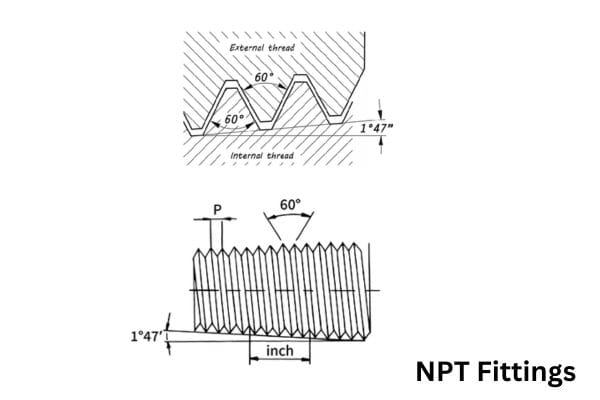
What Is an NPT Thread?
NPT stands for National Pipe Taper. It is a 60-degree tapered pipe thread covered by ASME B1.20.1.
Both the male and female NPT threads are tapered at 1:16 on diameter. As the connection is tightened, interference increases between the mating threads. However, small clearances may remain between the thread crests and roots, so an appropriate pipe-thread sealant is normally used for pressure service.
NPT should not be described as universally self-sealing. Its performance depends on thread condition, engagement, sealant, fitting and port materials, assembly procedure and the design of the complete component.
Technical Specifications
| Item | UNF | NPT |
| Full name | Unified National Fine | National Pipe Taper |
| Thread shape | Straight / parallel | Tapered |
| Thread angle | 60° | 60° |
| Size designation | Nominal diameter and TPI | Nominal pipe size and TPI |
| Primary function | Fastening and clamping | Tapered pipe connection |
| Hydraulic sealing | Depends on the complete end type | Thread interference with compatible sealant |
| Common hydraulic examples | JIC 37° flare, SAE ORB | NPT ports and pipe adapters |
| Sealing location | Flare seat, O-ring or other specified interface | Along the assembled tapered thread |
| Sealant | Determined by the fitting design; not applied to JIC flare or ORB sealing surface | Normally required for pressure service |
| Direct compatibility | Not compatible with NPT | Not compatible with UNF |
| Main identification point | Parallel diameter along the thread | Diameter changes along the thread |
| Applicable reference | Unified thread and component standards | ASME B1.20.1 |
The Thread Is Not Always the Sealing Surface
One of the most important differences between UNF-based hydraulic connections and NPT connections is the location of the fluid seal.
JIC 37-Degree Flare
JIC fittings commonly use straight Unified threads, but the fluid seal is formed between the male 37-degree cone and the female flare seat. The thread pulls the two sealing surfaces together.
Applying thread sealant to the JIC threads does not repair a damaged or mismatched flare seat.
SAE O-Ring Boss
SAE ORB connections also use straight Unified threads. The fluid seal is created by an O-ring compressed against the port chamfer or sealing surface.
The thread provides retention and clamping force. The O-ring material, groove condition, port dimensions and surface quality determine sealing performance.
NPT Connection
NPT does not use a separate flare seat or O-ring as its standard sealing interface. The tapered male and female threads develop increasing interference during assembly, and a compatible sealant normally fills the remaining leakage path.
This is why thread diameter and TPI alone are not enough to select a hydraulic fitting. The connection type and sealing interface must also be identified.
UNF in JIC and ORB Connections
UNF threads are commonly found in JIC 37-degree flare and SAE O-ring boss connections. In both systems, the straight thread provides engagement and clamping force, but it is not the primary fluid-sealing surface.
This distinction is important when identifying fittings, selecting replacements and investigating leakage. Matching the UNF thread size alone does not prove that two hydraulic components have the same connection type.
UNF Threads in JIC 37-Degree Flare Connections
A JIC connection normally consists of a male fitting with a 37-degree cone and a female fitting or tube end with a matching 37-degree flare seat.
During assembly, the straight thread draws the two 37-degree surfaces together. The metal-to-metal contact between these surfaces creates the fluid seal.
The UNF thread performs three main functions:
- Aligning the male and female components
- Pulling the two flare surfaces together
- Maintaining the required clamping force after assembly
The thread itself is not intended to provide the hydraulic seal. Applying PTFE tape or pipe-thread compound to a JIC thread does not correct a scratched, distorted or mismatched flare seat.
UNF Threads in SAE O-Ring Boss Connections
An SAE O-ring boss connection uses a straight male thread, an O-ring and a specially machined female port.
As the fitting is installed, the O-ring enters the port chamfer and is compressed against the sealing surface. The O-ring forms the fluid seal, while the thread retains the fitting in the port.
The UNF thread provides:
- Mechanical engagement with the port
- Axial retention
- Positioning of the fitting
- Compression control for the O-ring sealing area
The O-ring material must be compatible with the hydraulic fluid, operating temperature and system conditions. The port chamfer and sealing surface must also be free from scratches, burrs and contamination.
JIC and ORB Are Not Interchangeable
JIC and ORB connections may use the same straight thread size in some configurations, but their sealing structures are different.
| Item | JIC 37° Flare | SAE O-Ring Boss |
| Thread form | Straight Unified thread | Straight Unified thread |
| Primary seal | 37° metal-to-metal flare | O-ring against the port sealing surface |
| Male-end feature | 37° cone | O-ring groove and sealing O-ring |
| Female-side feature | 37° flare seat | Machined port chamfer |
| Thread sealant | Not used to create the flare seal | Not used to replace the O-ring |
| Main inspection point | Cone and flare surfaces | O-ring, groove and port chamfer |
Factors to Consider When Choosing Between UNF and NPT
Choosing between UNF and NPT should not be reduced to “precision versus pressure.” Both thread systems can be used in hydraulic equipment, but they belong to different connection designs and use different sealing methods.
Begin with the equipment specification, mating port and required sealing interface. Then review the operating conditions, material compatibility and assembly requirements.
Existing Port and Connection Standard
The existing port or mating component should be the first consideration.
Use the connection specified by:
- Equipment drawing
- Port marking
- Existing part number
- Component catalog
- Applicable fitting standard
- Manufacturer’s instructions
UNF is a straight-thread series and may be used in hydraulic connections such as JIC 37-degree flare and SAE O-ring boss. NPT is a tapered pipe thread used in ports and adapters designed for tapered thread engagement.
UNF and NPT should not be connected directly. If the system requires a transition, use a purpose-designed adapter with the correct connection on each end.
Sealing Method
Confirm where the connection forms its fluid seal.
JIC connections: The straight Unified thread pulls the male 37-degree cone against the female flare seat. The metal seat—not the thread—forms the seal.
SAE O-ring boss connections: The straight Unified thread retains the fitting, while an O-ring seals against the port chamfer or sealing surface.
NPT connections: The male and female tapered threads develop increasing interference during assembly. A compatible pipe-thread sealant is normally used to fill the leakage path that may remain between the thread crests and roots.
Select the complete connection type, not the thread designation alone.
Operating Pressure
Do not select NPT automatically because the system operates at high pressure. UNF-based JIC and ORB connections are also widely used in hydraulic systems.
The allowable working pressure depends on:
- Fitting size
- Material
- Wall thickness
- Port design
- Sealing interface
- Thread engagement
- Manufacturing quality
- Pressure cycling
- Applicable component standard
- Assembly testing
Use the pressure rating assigned to the complete fitting, adapter or port. UNF and NPT do not have one universal pressure rating.
Can UNF and NPT Connect Directly?
No. UNF and NPT threads should not be connected directly.
Although both normally use a 60-degree thread angle, their geometry, size systems and sealing methods are different:
- UNF is a straight thread: Its diameter remains substantially constant along the threaded length.
- NPT is a tapered thread: Its diameter changes along the threaded length at a 1:16 taper on diameter.
- UNF-based hydraulic connections use a separate seal: JIC fittings seal at a 37-degree flare, while ORB fittings seal with an O-ring.
- NPT seals along the tapered thread: A compatible pipe-thread sealant is normally required to block the remaining leakage path.
A UNF component may begin to engage with an NPT port in some size combinations, but this does not indicate compatibility. Continued tightening can cause:
- Cross-threading
- Incomplete engagement
- Thread deformation
- Damage to the female port
- Incorrect assembly depth
- Fluid leakage
- Failure during pressure service
Do not use additional torque, PTFE tape or thread compound to compensate for mismatched threads.
Use the Correct Transition Adapter
When a UNF-based connection must connect to an NPT port, use a purpose-designed adapter with the correct connection on each end, such as:
- JIC male to NPT male
- JIC female to NPT male
- ORB male to NPT female
- ORB male to NPT male
Before selecting the adapter, confirm:
- JIC, ORB or other UNF-based end type
- Thread size and TPI
- NPT nominal pipe size
- Male or female configuration
- Sealing interface
- Material and surface finish
- Working-pressure rating
- Operating fluid and temperature
A matching diameter or partial hand fit does not prove interchangeability. Verify both adapter ends against the equipment drawing, port specification or approved part number before installation.
Installation Techniques and Best Practices
UNF Thread Installation
Tips for Ensuring Precise Alignment and Avoiding Cross-Threading:
Alignment Tools: Use alignment jigs or fixtures to guide the components into place. This ensures that the threads engage smoothly without misalignment.
Visual Inspection: Before tightening, visually inspect the threads to ensure they are properly aligned. A slight adjustment may prevent cross-threading.
Gentle Engagement: Start threading by hand to ensure that the initial engagement is smooth. Avoid using excessive force, as this can lead to cross-threading.
Thread Cleaning: Ensure that both the male and female threads are clean and free from debris before installation. Any particles can cause misalignment or damage.
Lubrication and Torque Considerations for Optimal Performance:
Lubrication: Apply a light coating of appropriate lubricant (e.g., anti-seize compound) to the threads before installation. This reduces friction, helping achieve the correct torque during tightening and preventing galling.
Torque Specifications: Adhere to the manufacturer’s torque specifications for UNF threads. Using a calibrated torque wrench ensures that the connection is neither too loose nor over-tightened, which could compromise performance.
Check for Movement: After installation, verify that there is no unintended movement or looseness in the assembly. Regular checks should be conducted, especially in high-vibration environments.
NPT Thread Installation
Using Sealants (e.g., PTFE Tape) for Tapered Threads to Prevent Leaks:
Application of Sealant: Wrap PTFE tape around the male threads in the direction of the threading (clockwise). This ensures that the tape does not unravel when the fitting is tightened.
Thickness Consideration: Use a suitable thickness of tape—typically, two to three wraps are sufficient. Excess tape can make tightening difficult and may compromise the seal.
Alternative Sealants: For some applications, thread compounds or liquid sealants may be used instead of tape. Ensure compatibility with the fluids being transported.
Proper Tightening Techniques to Maintain Pressure Integrity:
Initial Tightening: Start with hand-tightening to establish a good fit, then use a wrench for final tightening. This helps to engage the threads without over-compressing them initially.
Incremental Tightening: Tighten gradually in small increments rather than attempting to achieve the final torque in one motion. This method helps to distribute stress along the threads evenly.
Torque Specifications: Like UNF threads, follow the manufacturer’s torque specifications for NPT connections to ensure adequate sealing and structural integrity without damaging the threads.
Common Pitfalls and How to Avoid Them
Cross-Threading:
Avoiding Mistakes: Cross-threading can occur when components are misaligned during installation. Always start threading by hand and ensure components are properly aligned before applying torque.
Over-tightening:
Consequences: Excessive tightening can strip threads or damage components, leading to leaks or failures. Always use a torque wrench and adhere to recommended specifications.
Inadequate Cleaning:
Importance of Clean Threads: Failing to clean threads can lead to debris causing poor engagement or damage. Always clean both male and female threads before installation.
Incorrect Use of Sealants:
Sealant Mistakes: Using too much PTFE tape or the wrong type of sealant can result in leaks. Follow application guidelines and ensure compatibility with the intended fluids.
Ignoring Environmental Conditions:
Adaptation to Conditions: Failing to consider temperature and pressure requirements can lead to inadequate performance. Always assess environmental factors that may affect thread integrity and sealing.
Conclusion
For best results, always consult with a professional or an engineer when selecting the appropriate thread type for your application. A thorough understanding of the environmental conditions, system requirements, and technical specifications is essential for making an informed decision. Additionally, referring to established standards, such as ANSI or ISO guidelines, ensures compatibility and safety in critical applications. Always use reliable sources and adhere to manufacturer recommendations to optimize performance and safety in your threaded connections.
FAQ
What is the main difference between UNF and NPT threads?
UNF threads are fine and straight, designed for precision applications, while NPT threads are tapered, making them ideal for creating seals in piping systems and hydraulic applications.
Can UNF and NPT threads be used interchangeably?
No, UNF and NPT threads are not compatible due to differences in their pitch, angle, and design. UNF threads are straight and fine, while NPT threads are tapered, which means they cannot be connected without risking leaks or damage.
Where are UNF threads commonly used?
UNF threads are typically used in industries requiring high precision and strength, such as aerospace, automotive, and medical equipment manufacturing, where tight tolerances and secure connections are essential.
What applications are suitable for NPT threads?
NPT threads are commonly used in plumbing, hydraulic systems, and the oil and gas industry. Their tapered design allows them to form a tight, pressure-resistant seal, which is critical for fluid and gas transport.
What sealant should be used with NPT threads?
PTFE tape or pipe thread compounds are recommended for NPT threads to enhance the sealing capability, as their tapered design alone may not be sufficient to prevent leaks in all pressure scenarios.
How do I prevent cross-threading with UNF threads during installation?
To avoid cross-threading, start threading the components by hand and ensure they are perfectly aligned before using tools to tighten them. Lubricating the threads can also help achieve smooth engagement and proper alignment.