
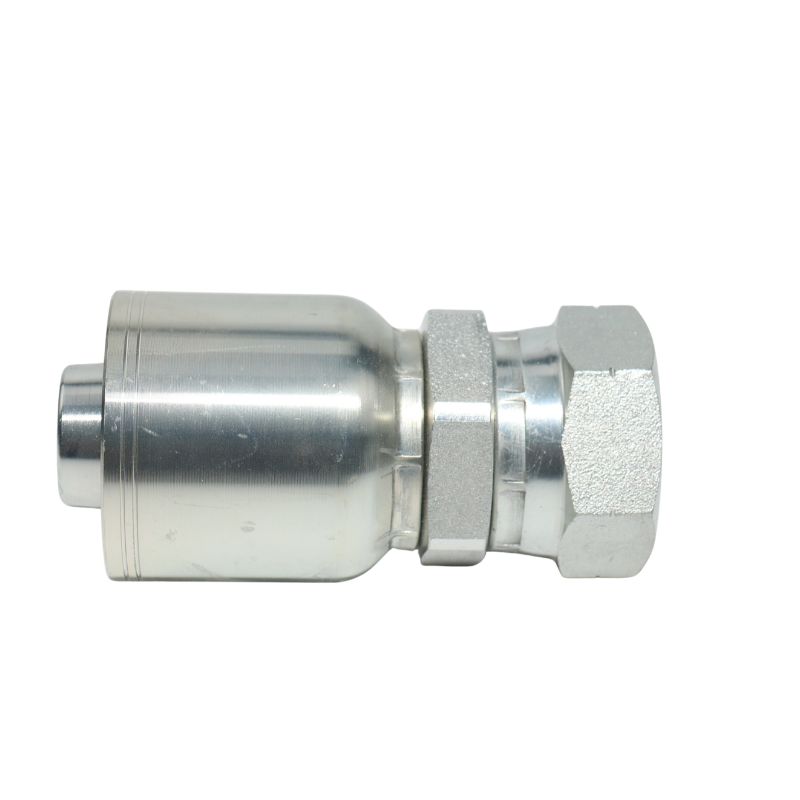
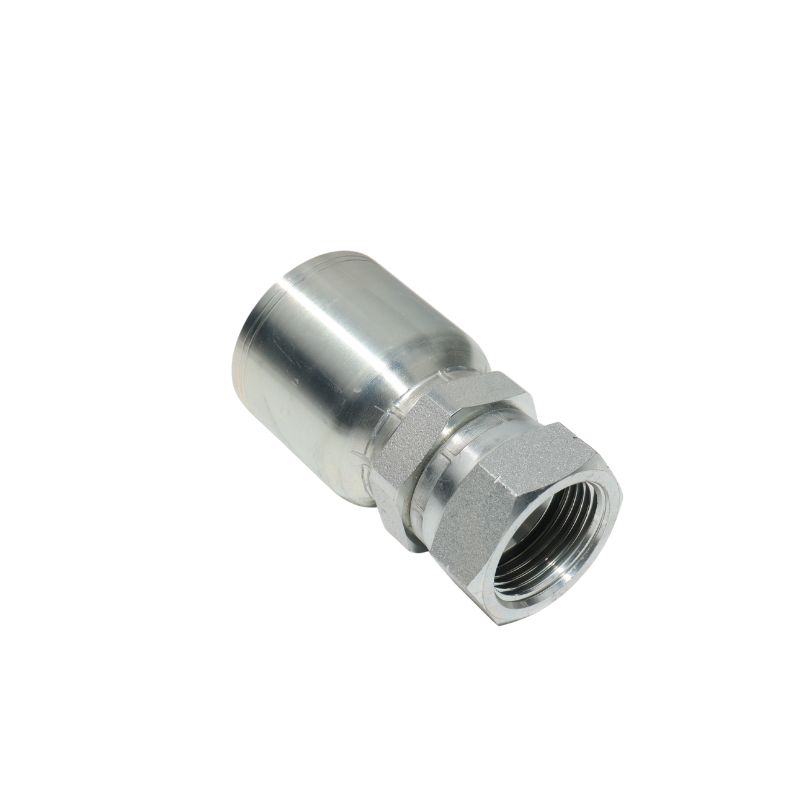
“Female swivel” is not a complete hydraulic fitting specification. It tells you that the connection is female and that the nut or connection can rotate for assembly, but it does not identify the thread standard, seat angle, sealing method, hose size, or fitting shape. In Parker 43 Series alone, the phrase can point toward a Female JIC 37° Swivel, a Female SAE 45° Swivel, or a Female NPSM Pipe Swivel with a 60° cone. Sending any candidate before those features are confirmed can produce a part that will not thread on, appears to tighten but cannot seal, or cannot be crimped to the intended hose.
Female and Swivel Describe Only Two Features
Gender does not identify the connection
“Female” means the fitting has an internal mating connection, but many standards use female ends. JIC, SAE 45° flare, NPSM, BSPP, metric, DIN, ORFS, and other systems can all include female configurations, and each depends on its own combination of thread and sealing geometry. Gender therefore narrows the search without selecting a standard. If a part request stops at female, the most important technical question—what surface actually creates the seal—remains unanswered.
Swivel does not identify the seal either
“Swivel” normally means a nut or end component can rotate relative to the hose stem so the connection can be assembled without twisting the hose. It does not mean the fitting is a rotary union, and it does not define whether the joint seals on a 37° seat, a 45° seat, a 60° cone, an O-ring face, or another surface. A swivel feature may look similar across product families while the internal geometry is incompatible. Treat movement as a functional feature and the sealing interface as a separate specification.
Three Parker 43 Candidates Fit the Same Description
The catalog names expose the ambiguity
Three straight styles demonstrate the problem clearly: 10643 is Female JIC 37° Swivel, 10843 is Female SAE 45° Swivel, and 10743 is Female NPSM Pipe Swivel with a 60° cone. These are not three names for one interchangeable fitting. They are three distinct port-end systems that happen to share gender, movement, and a one-piece crimp-fitting family.
Each candidate answers a different interface
The correct candidate is determined by the mating male connection, not by the words female swivel alone. The JIC version requires the matching 37° flare system; the SAE 45° version requires its corresponding 45° flare; the NPSM swivel uses straight pipe threads and a 60° cone to mate with the intended pipe connection. Thread engagement is only one part of the decision because the sealing surfaces must also meet correctly, with the proper diameter, pitch, cone position, and contact area for that standard. A nut that starts on the male thread does not prove the standard or the seal, and using tightening force to overcome unexpected resistance can damage both parts before the identification error is recognized.
| Parker 43 style | Catalog description | Primary sealing feature | What must be confirmed |
| 10643 | Female JIC 37° Swivel | 37° metal seat | JIC thread size, pitch, and matching 37° male flare |
| 10843 | Female SAE 45° Swivel | 45° metal seat | SAE 45° thread size, pitch, and matching 45° male flare |
| 10743 | Female NPSM Pipe Swivel | 60° cone mechanical seat | NPSM thread and the intended male pipe connection and cone |
Why the Wrong Part May Look Convincing
Straight threads can hide a seat mismatch
Two fittings can have internal straight threads and rotating nuts yet seal at different angles. The thread may draw the parts together, but it cannot change a 37° seat into a 45° seat or create full contact where the cone geometry differs; apparent tightening may come from edge contact rather than correct seating. Partial line contact can mark or deform the sealing faces without establishing the intended seal, and a brief low-pressure check cannot establish that the joint will tolerate working pressure, impulse, vibration, and temperature cycles. This is why JIC and SAE 45° fitting identification requires seat-angle verification as well as thread measurements, especially when a used fitting has wear marks that make the cone appear flatter or steeper than it is.
Size language creates a second source of error
You may provide a hose dash size, nominal pipe size, thread diameter, wrench size, or a dimension taken across the swivel nut and call all of them “the fitting size.” Those values are not interchangeable, and converting a measured diameter directly into a nominal pipe or flare size can select the wrong row in a catalog. Parker part-number suffixes can describe port and hose combinations, including reducer arrangements where both sides are not the same dash size; even a correctly identified 10643, 10843, or 10743 base style may therefore have several possible suffixes. Record the hose side and connection side in separate fields, note whether each value is nominal or measured, and verify both against the current catalog rather than assuming that one spoken number fills both positions.
Identify Thread, Seat, and Seal Separately
Use a repeatable measurement sequence
Identification should begin only after the equipment is shut down, isolated, and relieved of hydraulic pressure and stored energy according to the equipment manufacturer’s procedure. Clean the old fitting without damaging the threads or seat, then examine markings and the complete part number before measuring; keep the mating male part available because it can reveal the intended cone and standard more clearly than a worn female nut. Photographs can document the overall shape and visible condition, but photographs alone rarely distinguish small angle differences, show the bottom of a recessed seat, or establish an exact thread. Use calibrated calipers, a thread-pitch gauge, and the appropriate seat or angle gauge, then compare several independent features with controlled manufacturer data so one damaged dimension does not control the decision.
Follow this sequence:
- Confirm female gender and whether the swivel is straight, 45°, 90°, or another shape.
- Measure the internal thread diameter using the correct method and identify pitch or TPI.
- Determine whether the thread is straight or tapered; do not infer this from a single photograph.
- Inspect and gauge the sealing surface: 37° flare, 45° flare, 60° cone, O-ring face, or another form.
- Record the mating male fitting, port standard, old part number, and any readable markings.
- Reject any candidate whose thread and sealing method are not both confirmed.
Do not use sealant to repair identification errors
Thread sealant cannot convert a mismatched flare or cone into the correct sealing system. JIC and SAE flare connections are designed to seal at their mating metal seats, while the NPSM swivel depends on its intended mechanical cone connection rather than sealing on the straight threads. Adding sealant can hide evidence, contaminate the system, or create false confidence without correcting the geometry. If the fitting does not have full, specified contact at the intended sealing surface, stop and identify the connection again.
The Hose and Crimp Side Can Still Be Wrong
One-piece construction reduces only one class of error
A one-piece hydraulic hose fitting normally combines or retains the hose stem and ferrule as one assembly, although construction varies by series. This can reduce the risk of picking a separate ferrule that belongs to another stem family. It does not prove that the hose construction, hose ID, port end, pressure conditions, or crimp process are compatible. The Parker 43 family name narrows the product system, but the exact fitting suffix and approved hose combination still control the assembly.
Confirm current assembly data for the exact combination
After the port end is identified, verify the hose manufacturer and series, hose ID or dash size, fitting part number, preparation method, insertion depth, crimper, dies, and final crimp inspection limits. There is no universal crimp diameter for all female swivel fittings or all hoses of one dash size, and matching a nominal ID does not prove that the stem serrations, ferrule, reinforcement layers, or assembly method are compatible. The working pressure of the finished assembly is limited by its lowest-rated component and affected by temperature, fluid, impulse, routing, and installation conditions, so the port end cannot be approved independently of the completed hose assembly.
Replace the Vague Request With a Controlled Check
Ask for evidence that closes each gap
A useful clarification request should be short enough to answer but precise enough to eliminate the three candidate families. Asking only for another photo usually repeats the problem, especially when the seat is hidden inside the swivel nut. Request the mating connection or port information together with measured thread and seat data. The one-piece fitting photo and detail checklist helps organize views of the complete fitting, threads, sealing face, hose end, and markings.
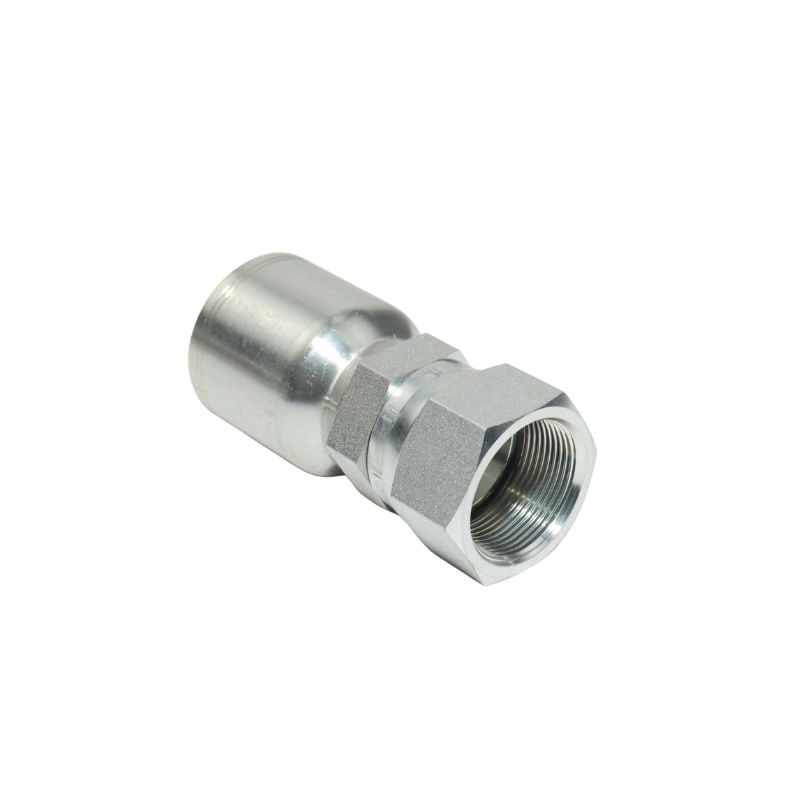
Request these details before selecting a part:
- Complete old part number and clear photos of the entire fitting, nut, threads, and seat.
- Thread inside diameter, pitch or TPI, and straight-versus-tapered confirmation.
- Seat or cone angle and the sealing method of the mating male connection.
- Hose manufacturer, hose series, hose ID or dash size, and readable layline.
- Straight or elbow shape, orientation, overall dimensions, and installation clearance.
- Working pressure, temperature, fluid, material, finish, and application conditions.
- Crimping machine, dies, and the current crimp specification intended for assembly.
Approve the exact finished assembly
Cross-reference data should generate possible candidates, not a declaration that products are fully interchangeable. Compare the original and candidate drawings, inspect a low-risk sample made with the exact hose and controlled crimp process, and verify fit at the actual port while the system remains safely depressurized; the nut should engage normally, the specified seat should contact correctly, and the hose should follow its route without preload or an excessive bend. Record the part number, drawing revision, thread and seat measurements, hose and crimp results, installation position, and approval conditions so future orders do not return to the phrase female swivel. If any safety-critical field remains unknown, label the identification incomplete instead of choosing the closest-looking part, and obtain the equipment, port, hose, or crimper manufacturer’s current data before proceeding.
Conclusion
The correct decision requires the mating standard, internal thread diameter, pitch, straight or tapered form, seat angle, sealing method, hose series and size, fitting shape, application conditions, and valid crimp data. Prepare measured evidence and a complete original part number, then approve the finished hose assembly rather than relying on two generic words.
FAQ
Can thread diameter alone distinguish JIC 37° from SAE 45°?
No. Measure the pitch and verify the seat angle and standard because identification requires both the thread and the sealing geometry.
Does swivel mean the connection can rotate continuously under pressure?
No. A swivel nut commonly supports assembly alignment; continuous rotation requires a component specifically designed and rated as a rotary connection.
Can a female NPSM swivel seal with ordinary thread sealant?
Do not treat sealant as the sealing method because the intended NPSM swivel connection relies on its specified mechanical seat and mating part.
If the hose dash size matches, can the replacement be approved?
No. Hose size does not confirm hose construction, fitting series, port standard, seat, pressure suitability, or crimp data.
What is the fastest reliable starting point for identification?
Use the complete old part number and mating-port specification, then confirm them with thread, seat, hose, shape, and crimp information.