
Full traceability exists when a physical fitting or controlled package can be linked to its part identity, batch, purchase order line, receiving and inspection records, inventory movement, and later shipment. The chain breaks whenever one of those links depends on memory, appearance, or a label that disappears after unpacking. Hydraulic fitting traceability should use a small set of consistent identifiers across physical parts, inner packages, cartons, and business records while preserving original supplier references.
Traceability Breaks at Handoffs
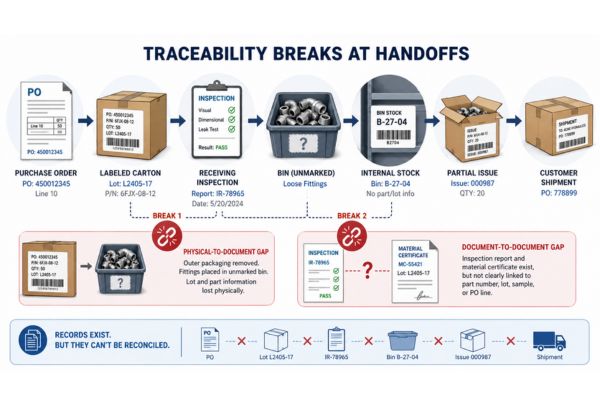
Most systems fail between records rather than inside one record. A purchase order may be complete, a carton label readable, and an inspection report detailed, yet none helps if their identifiers cannot be reconciled.
Physical-to-document gaps
A common break occurs when outer packaging is discarded and loose fittings enter an unmarked bin. Another occurs when a receiving team creates an internal code but does not retain the supplier lot or purchase order link. Later, a questioned fitting can be identified only by appearance, which is unreliable for similar thread, dash, finish, or hose-side variants.
The chain should survive normal handling: opening cartons, dividing quantities, moving stock, issuing partial amounts, returning parts, and repacking for shipment. Every transformation needs a controlled record or label that carries forward the identifiers required for later lookup.
Document-to-document gaps
An inspection report that states “item passed” without part number, lot, sample, or order line cannot be assigned confidently to inventory. Likewise, a material certificate with a heat number has limited value if no production or batch record connects that heat to the delivered fittings.
Map each handoff before choosing software. The essential question is whether a reviewer can travel from one fitting or package backward to receiving and material evidence, then forward to every affected location or shipment.
Separate Part Identification From Batch Traceability
Part identification answers what the fitting is intended to be. Batch traceability answers which production or received group the specific fitting belongs to. One identifier should not be forced to perform both jobs unless the coding design explicitly supports that relationship.
Product identity fields
An effective product description differentiates connection type, port and hose size combination, fitting series, straight or elbow orientation, and any controlled material or finish variant. Internal, customer, and supplier part numbers may coexist, but a mapping table should show which codes refer to the same approved item and revision.
A correct part number helps prevent picking errors, yet it does not identify when or under which evidence the fitting was produced or received. That requires a lot or batch reference.
Lot and batch fields
A lot or batch groups parts under a defined traceability rule, such as a production, inspection, or receiving grouping. The organization should define what causes a new identifier rather than assume the term has a universal meaning. Material changes, finish batches, production runs, mixed sources, or receiving events may require separate controls depending on the risk and agreement.
The core distinction can be recorded as:
- Part number or controlled description: what the item is
- Revision or specification state: which approved definition applies
- Lot or batch number: which traceable group includes the item
- Quantity and unit: how much of that group is present or moved
- Location or transaction: where it went and when
Preserve Identity From Fitting to Carton
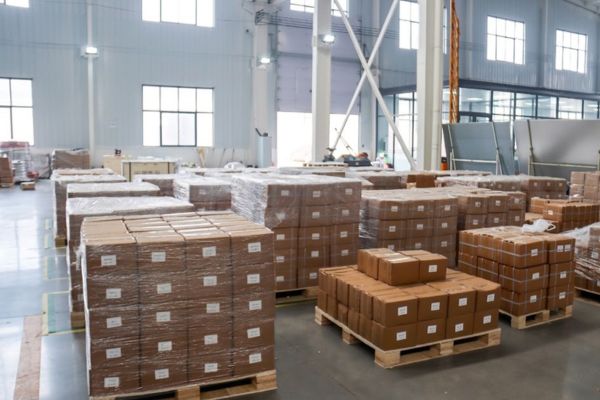
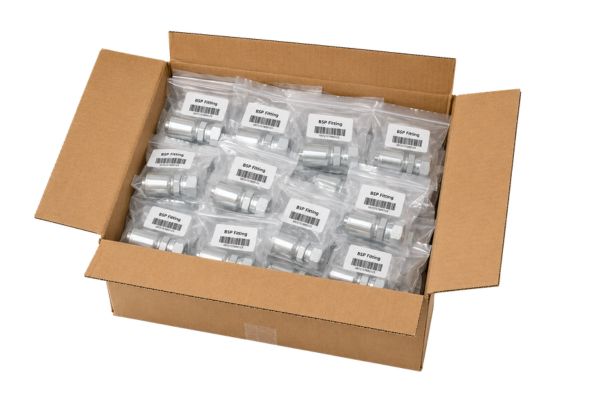
Packaging levels should form a nested chain rather than independent labels. If individual fittings are unmarked, the smallest controlled package must preserve identity until the contents are consumed or relabeled safely.
Individual and inner-package control
Some fittings carry durable part or batch marks, while others cannot accommodate complete information. Marking feasibility varies with size, geometry, surface requirements, and the approved specification. When individual marking is absent, use inner bags, trays, compartments, or bins that prevent uncontrolled separation from the label.
The inner label should contain enough information to avoid confusion with similar items. It may use a code linked to the full database record, but users must be able to retrieve the description, size combination, batch, and quantity without relying on a private spreadsheet or one employee’s knowledge.
Carton and hierarchy links
The outer carton label should identify the contained part numbers, batches, quantities, and a shipment or packing reference. If a carton contains multiple allowed lines, list them clearly rather than assign one ambiguous code. A parent carton ID can link to child package IDs, reducing label clutter while maintaining detail.
| Physical or record level | Minimum linkage purpose | Failure to avoid |
| Individual part or smallest package | Preserve product and batch identity | Loose unidentified fittings |
| Inner package | Separate SKU, batch, and quantity | Mixed lots after carton opening |
| Outer carton | Link contents to packing and shipment | One label used for unlike contents |
| Receiving record | Connect delivered packages to order lines | Unassigned inspection evidence |
| Inventory transaction | Preserve batch during moves and issues | Lot identity lost in storage |
Link Cartons to Purchase Orders and Order Lines
Order-level traceability is too broad when one purchase order contains many sizes, finishes, or fitting configurations. Each package and receiving entry should point to the exact order line or another unambiguous line-level record.
Maintain code mappings
The purchase order may use a buyer code, the packaging a supplier code, and downstream shipping a customer code. Keep a controlled mapping among them, including revision and description. Do not assume identical dash values or similar Parker-style cross-reference terms prove that two codes represent the same complete fitting.
The order line should define the expected part, quantity, material or finish requirement, documentation, and batch-labeling requirement. Any approved substitution or revised cross-reference must be recorded before receiving so inspectors do not create an unofficial mapping at the dock.
Reconcile quantity and package identity
Receiving should reconcile carton and inner-package quantities to the order line while preserving each lot. Partial deliveries, split cartons, and overages need explicit records. If the same part arrives in two batches, receiving them as one undifferentiated quantity destroys the batch link before inspection begins.
Record discrepancies and quarantine affected packages until their identity is resolved. Relabeling should add internal control while retaining the original supplier and order references.
Connect Receiving, Inspection, and Inventory
Traceability becomes operational when accepted, held, rejected, and conditionally released material remain distinguishable in storage. A complete historical record is useless if the warehouse cannot locate the affected pieces.
Receiving and inspection relationship
Assign a receiving record to every delivered package or logical lot and connect inspection samples to that identity. The inspection record should show the part, batch, applicable drawing or specification, characteristics checked, method, result, date, and disposition. Material, coating, dimensional, and thread reports should reference the same batch or an auditable upstream link.
Sampling does not mean every piece was inspected. The record must state what was sampled and which lot the decision covers under the approved plan. Traceability supports that scope; it should never be used to imply inspection that did not occur.
Inventory moves and partial issues
When accepted stock moves to another bin, branch, kit, assembly area, or shipment, record part, batch, quantity, origin, destination, date, and transaction reference. If a quantity is split, both child quantities should retain the source batch. If batches are intentionally combined, the system must preserve the many-to-one relationship and the procedure must allow it.
Useful transaction fields include:
- Part number, revision, and batch
- Quantity moved, issued, returned, or scrapped
- From and to locations
- Transaction date and responsible record
- Work order, shipment, or customer-order reference
- Quality status and any hold or deviation code
Use Traceability for Containment and Investigation
The practical value of the chain appears when a possible nonconformity is discovered. Teams should identify affected stock and shipments quickly without blocking unrelated material.
Backward and forward tracing
Backward tracing starts with a fitting, package, or shipment and finds its batch, receiving record, inspection evidence, order line, and upstream material or finish records. Forward tracing starts with a questioned batch or certificate and finds every inventory location, issue, assembly record, or shipment that may contain affected parts.
Both directions matter. Backward tracing supports root-cause review; forward tracing supports containment. A system that can perform only one leaves either the cause or the affected population uncertain.
Nonconformity and corrective action
A nonconformity record should identify the characteristic, actual condition, requirement, batch, discovered location, containment, and disposition. Corrective action records may then link causes and preventive changes to the same product and process identifiers. Do not overwrite the original data when a correction occurs; preserve history and explain the change.
Traceability does not prove conformity. It helps identify, isolate, review, and act on possible nonconformity in pressure-containing components. Technical acceptance still depends on verified dimensions, threads, sealing features, material, hose compatibility, crimp data, and application requirements.
Design the Chain Before Choosing Codes
A coding scheme should serve the required trace, not become the project itself. Start with the decisions users need to make, then select simple identifiers that are unique, scannable where useful, and maintainable across systems.
Step-by-step chain design
- Define product identity and the characteristics that create a separate SKU.
- Define what creates a new lot or batch for the relevant risk.
- Map supplier, buyer, and customer part-code relationships.
- Specify fields for inner labels, cartons, orders, receiving, and inspection.
- Preserve batch identity through storage, splits, issues, and returns.
- Test backward and forward searches with one to three sample packages.
- Document exception handling for missing, damaged, or conflicting labels.
The sample test should include a carton opening, partial issue, location transfer, and simulated lot hold. If the team cannot locate the remaining and issued quantities without manual reconstruction, the chain needs revision before rollout.
Keep identifiers stable and meanings controlled
Do not embed so many changing attributes in a part number that every revision creates confusion. A stable code linked to controlled master data may be easier to maintain than a long “smart” code. There is no universal coding system; the right design reflects product complexity, transaction volume, available tools, and investigation needs.
Access and edit controls matter. Users should not be able to reuse a batch number, silently change a code mapping, or release held stock without a recorded decision.
Common Labeling and Record Failures
Traceability weakens through small operational shortcuts. Repacking, returns, and mixed storage deserve as much attention as the original carton label.
Failure patterns
Common failures include multiple SKUs under one vague description, the same batch code reused for unrelated receipts, inspection reports saved without lot numbers, and accepted and held pieces in one bin. Handwritten relabeling may drop a digit or preserve the part number while losing the batch.
Avoid these conditions:
- Carton labels that do not identify all contained SKUs and batches
- Inner packages that lose identity after the carton is opened
- Inventory records that track quantity but not lot
- Returned fittings placed into stock without identity review
- Spreadsheets whose code mappings differ from the controlled system
Prevent silent breaks
Require an exception workflow for missing or damaged labels. The hydraulic fitting should be held while identity is reconstructed from reliable records and verified characteristics. Do not assign a convenient batch based only on location or appearance.
Periodic trace exercises can reveal links that look complete on screen but fail physically. Select an actual package, trace backward and forward, reconcile quantities, and document the gap rather than correcting records invisibly.
Traceability checklist
Confirm the controlled part description, size combination, revision, material or finish variant, and code mappings. Define the lot or batch rule, then carry its identifier through the smallest controlled package, carton, order line, receiving record, inspection reports, inventory transactions, and shipments.
Check that partial quantities, mixed packages, relabeling, transfers, returns, nonconformities, and holds preserve both identity and quantity. Test one to three representative paths in both directions before full use. Keep original records and document corrections. Most importantly, pair traceability with actual conformity evidence rather than treating a complete history as technical approval.
Conclusion
Full traceability depends on consistent links, not on the complexity of the code. Separate product identity from batch identity, preserve both at the smallest controlled package, and connect cartons to exact purchase order lines, receiving records, inspections, inventory moves, and shipments. Maintain supplier, internal, and customer code mappings without erasing original references. When stock is split, returned, relabeled, or moved, carry the batch and quantity history forward. Test backward and forward searches with real packages so silent gaps appear before a complaint or hold. Traceability supports containment and corrective action but cannot prove conformity by itself. Prepare the approved product definition, batch rule, label fields, transaction links, and exception workflow to build reliable hydraulic fitting traceability.
Frequently Asked Questions
Must every individual fitting carry a lot number?
Not always, because marking feasibility and requirements vary. When individual marking is absent, the smallest controlled package must preserve product and batch identity until parts are used or safely relabeled.
Is a carton label enough for full traceability?
No, the link is lost when parts leave the carton unless inner packages, bins, and transactions retain identity. The carton also needs connections to the order line, receiving, and inspection records.
Can one lot contain multiple purchase orders?
It may under a defined system, but the relationship must remain explicit and permitted by the traceability rule. Never infer the grouping after receipt merely because part numbers match.
How should returned fittings be handled?
Returns should remain controlled until part, batch, condition, and prior transaction history are verified. Untraceable returns should not be placed into accepted inventory based on appearance.
Does traceability prove a fitting meets specifications?
No, traceability identifies the fitting’s history and affected population. Conformity still requires appropriate dimensional, thread, sealing, material, assembly, and application evidence.