
A limited trial budget should be divided across models that test both real demand and meaningful supplier risk, not spent only on the cheapest or easiest fitting. Effective TP43 crimp fitting trial order model selection combines common configurations with a small number of difficult, decision-relevant variants, then applies the same packaging, documentation, and inspection controls expected in later orders. This approach gives a regional fitting business useful commercial evidence without pretending that a few samples approve an entire product family. The goal is to learn whether selected models can be identified, documented, received, and evaluated reliably while keeping technical assembly approval separate for every hose-and-fitting combination.
Why the Cheapest Models Provide Limited Evidence
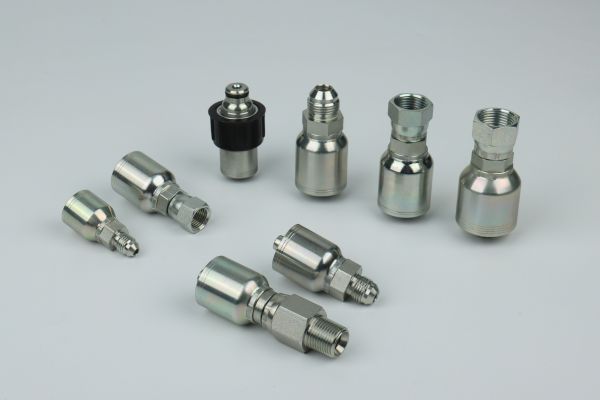
Low-cost straight fittings may confirm that an item can be ordered and delivered, but they reveal little about how consistently more demanding configurations are controlled. A trial that avoids elbows, swivel ends, less obvious dash combinations, or connection-specific sealing features may pass because it never tests the areas where descriptions, drawings, labels, or packing are most likely to fail.
Easy samples create a narrow result
A simple item can still be valuable when it represents repeat demand, because commercial validation should reflect what the business actually sells. The problem begins when every selected sample has the same low-complexity profile. A clean result then supports only those exact items and controls; it does not establish that the supplier can distinguish similar configurations, retain orientation details, or provide usable dimensional evidence for other models.
Price is one input, not the selection method
Unit price affects how many useful checks fit within a budget, but the trial should purchase information as well as parts. Each chosen model should answer a defined question about demand, technical identification, order processing, inspection, or packaging. If a model adds no new evidence and duplicates another item’s risk profile, it may consume budget without improving the decision.
Start with Demand and Risk Data
The strongest starting point is the business’s own demand history, corrected for stockouts, substitutions, and incomplete descriptions. Sales frequency alone is not enough: repeated emergency inquiries, returns caused by identification errors, and models that require frequent clarification can deserve trial attention even when their volume is lower.
Separate commercial signals from technical risk
Commercial data identifies which configurations matter to the market. Technical and operational data identifies which of those configurations are difficult to control. Review recent sales, lost inquiries, urgent requests, returns, manual corrections, and the connection systems common in the equipment population being served. Then flag items whose thread, sealing form, angle, port dash, hose dash, or orientation is often confused.
Useful selection inputs include:
- Verified demand by exact configuration rather than a broad family name.
- Frequency and consequence of identification, picking, or shipment errors.
- Local use of JIC, ORFS, NPT, flange, or other relevant connection systems.
- Availability of current drawings, dimension reports, hose-side data, and crimp specifications.
- The intended trial question, such as dimensional consistency, label clarity, or packaging separation.
Give each model a reason to exist in the trial
A selected model should represent a demand segment, expose a control risk, or provide a baseline for comparison. Recording that reason prevents a late change toward whichever sample is easiest to source. It also makes the final review more disciplined: a model passes or fails against its planned purpose, not against a vague impression of quality.
Balance Common and Difficult Configurations
A useful trial is neither a basket of only fast-moving straight fittings nor a collection of rare, highly unusual parts. Common models show whether routine business can be supported; difficult models test whether identification and control remain reliable when geometry or connection details become less forgiving.
Use common models as operational anchors
Fast-moving items help evaluate order confirmation, markings, count accuracy, packing, and repeatable incoming inspection. They also make later commercial conclusions more relevant because the trial includes products likely to be reordered. However, several common models that differ only slightly may produce redundant evidence unless those differences are themselves a known source of errors.
Add difficult models for defined risks
An elbow may test orientation and dimensional reporting. A female swivel may test the distinction between thread identity and sealing seat. A flange configuration may require clearer dimensional and connection evidence than a familiar straight threaded end. Select difficult items because they expose a known decision risk, not merely because they look impressive or are rare.
| Model role | Evidence it can provide | Selection caution |
| Common straight configuration | Routine order, label, packing, and dimension control | Too many similar items can duplicate evidence |
| Common elbow configuration | Routine demand plus angle and orientation control | Confirm the exact measurement reference |
| Difficult swivel or sealing end | Thread, seat, movement, and description control | Do not infer sealing identity from thread alone |
| Less common connection system | Capability to document a locally relevant exception | Do not choose a part with no realistic demand |
| Mixed port and hose dash item | Control of two size identities in one SKU | Require both sides to be stated unambiguously |
Test Connection Types, Angles, and Dash Combinations
The configuration mix should challenge the specific fields that drive correct identification. A family label such as TP43 does not replace confirmation of the connection end, sealing method, orientation, hose-side design, and applicable assembly data.
Keep port dash and hose dash separate
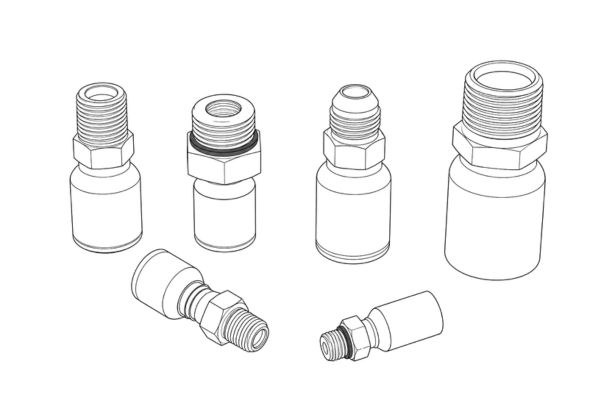
The connection size and hose size can differ, so a shorthand description can cause the wrong item to be quoted, labeled, or inspected. Include at least one decision-relevant configuration that tests whether both identities stay visible through quotation, order confirmation, packaging, and dimensional reporting. This is an order-control test, not proof that the fitting is compatible with a hose series.
For every selected model, record:
- Complete connection standard, gender, size, seat or sealing method, and shape.
- Port dash and hose dash in separate fields, without relying on an ambiguous combined code.
- Critical orientation or envelope dimensions for angled items.
- Hose-tail or fitting-series identity and the source of applicable crimp data.
- The exact question the configuration is intended to test.
Include Packaging and Documentation in the Trial
Parts that meet dimensional expectations can still create operational cost if their labels, packing, or evidence cannot support receiving and later picking. The trial should therefore use the same document and identification expectations that would matter for a normal stock order.
Packaging should preserve identity and condition
Check whether distinct SKUs remain separated and whether the label carries the agreed part identity, quantities, and revision-relevant description. Packaging should protect sealing faces, threads, swivel areas, and coating from avoidable contact or moisture exposure. A polished outer carton does not compensate for mixed inner packs or labels that omit the port-versus-hose distinction.
Documents must connect to the sample
A dimensional report is useful only when its item identity, drawing revision, measured characteristics, and sample relationship are clear. Photographs can support traceability, but they do not replace measurements or technical approval. Request evidence proportionate to the model’s risk and verify that the document follows the same naming convention used on the order and package.
The receiving review can check:
- Purchase description, package label, part marking, and report identity agree.
- Drawings define the critical dimensions and measurement references.
- Reports distinguish stated specifications from actual sample measurements.
- Packaging separates similar SKUs and protects functional surfaces.
- Any missing, substituted, or revised information is disclosed before approval.
Define Pass/Fail Criteria Before Ordering
Pass/fail criteria must be written before samples arrive, because post-arrival standards tend to shift toward accepting what is already on the table. Criteria should cover commercial execution, product identity, evidence quality, and incoming condition while clearly excluding untested family-wide claims.
Use model-specific and process-level criteria
Model-specific criteria address the connection, dimensions, geometry, hose-side identity, and condition of the exact sample. Process-level criteria address quotation clarity, revision control, label accuracy, packing separation, report linkage, and response to discrepancies. A supplier may pass one layer and fail another, which is more informative than a single overall score.
Keep assembly approval separate
Commercial validation asks whether the selected order can be controlled and supported. Technical assembly approval asks whether an exact hose, fitting, ferrule arrangement, crimp specification, equipment setup, pressure requirement, temperature, fluid, and application combination is suitable. Do not approve the full TP43 range, or even a tested-looking model for assembly, solely because dimensions and packaging passed incoming review.
Before ordering, define outcomes such as:
Pass: all critical identity, dimensional, condition, packaging, and evidence requirements are satisfied for the exact model. Conditional review: a non-safety-critical discrepancy is documented, corrected, and rechecked before any expansion decision.
Fail: critical identity, sealing, geometry, traceability, or required evidence is missing or inconsistent. Not evaluated: hose compatibility, crimp performance, or application suitability was outside the trial and remains unapproved.
Avoid Common Trial-Selection Mistakes
Most weak trials fail at the planning stage rather than the inspection bench. The recurring errors are choosing models for convenience, allowing unclear descriptions, and drawing a broader conclusion than the selected evidence supports.
Watch for unbalanced or redundant selections
Choosing only inexpensive common items under-tests difficult controls, but choosing only unusual items can distort the commercial decision and create problems unrelated to normal demand. Another mistake is selecting several models that test the same easy attribute while omitting angle, swivel, sealing, or dash-combination risks. A balanced trial uses the smallest set that still answers distinct, high-value questions.
Do not move the acceptance boundary afterward
Changing critical dimensions, evidence requirements, or identity fields after delivery makes comparison unreliable. Avoid accepting an undocumented substitution because it appears close, and do not use a recognizable brand-style number as proof of geometry or compatibility. Discrepancies should remain visible in the decision record so the next order does not repeat them.
Neutral TP43 Trial-Selection Checklist
The final selection should be auditable before a purchase order is released. A short worksheet can show why each model was included, what evidence it should produce, and which questions remain outside the trial.
Information to approve before release
- Demand source and commercial importance of each exact configuration.
- Full connection, sealing, angle, port-dash, and hose-dash description.
- Drawing, dimension-report, marking, label, and packaging expectations.
- Model-specific pass/fail criteria and discrepancy-handling rules.
- Required hose, fitting, and crimp data for any later assembly validation.
- Explicit limits on what the sample result can approve.
The completed worksheet should also identify who reviews commercial execution, incoming dimensions, and technical assembly suitability. Separating these responsibilities reduces the chance that a clean package or familiar appearance is mistaken for engineering approval.
Conclusion
A limited budget produces useful evidence when every TP43 crimp fitting is selected for a clear demand or risk question. Combine commercially relevant straight and angled items with a few configurations that test swivel ends, connection systems, dash identities, documentation, and packaging controls. Define critical descriptions, measurements, evidence, and pass/fail rules before ordering, then record what was not evaluated. Common models keep the trial connected to future sales, while difficult models reveal whether higher-risk details remain controlled. Neither group should dominate without a business reason. Most importantly, treat incoming and commercial results as evidence for the exact samples only. Complete TP43 trial order model selection should prepare the next verification step, including current hose, fitting, crimp, pressure, temperature, fluid, and application data.
FAQ
Can one successful TP43 sample approve other sizes?
No, one successful sample supports only the characteristics and controls actually evaluated. Other sizes or connections can change geometry, ratings, hose-side requirements, and manufacturing controls, so they need proportionate verification.
Should the highest-volume model always receive the most trial attention?
Not automatically, although demand is an important input. A lower-volume model may deserve attention when an identification or configuration error would be difficult to detect or costly to correct.
Is a dimensional report enough to approve a trial fitting?
No, a dimensional report is one part of the evidence. Identity, sealing features, material and finish requirements, condition, traceability, hose compatibility, crimp data, and application limits may also require confirmation.
Should every trial include a flange or ORFS model?
Only when that connection is relevant to expected demand or a defined control risk. Adding an unrelated connection spends budget without producing useful evidence for the intended market.
Can packaging performance be evaluated with a small trial?
Yes, a small trial can reveal label clarity, SKU separation, surface protection, and document linkage. It cannot fully predict how packaging will perform across larger quantities, longer routes, or different storage conditions.