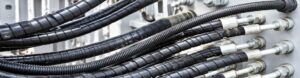
A 0.1mm crimping deviation causes serious hydraulic fitting leakage because it prevents the metal teeth of the fitting from biting deeply enough into the hose reinforcement to create a permanent, gas-tight seal. You may think a measurement thinner than a human hair is negligible, but in high-pressure systems, this tiny gap becomes a path of least resistance for pressurized oil. Leaving this unchecked leads to costly downtime, environmental hazards, and potential safety risks for your operators.
Why Is Precision Critical For Hydraulic Connections?
Precision is critical for hydraulic connections because it ensures the mechanical interface between the hose and fitting can withstand thousands of pounds of pressure without shifting. When you overlook even a fraction of a millimeter, the structural integrity of the entire assembly is compromised. This precision is what separates a reliable machine from one that suffers from frequent hydraulic fitting leakage.
Does 0.1mm Really Change The Compression Ratio?
You might be wondering if such a small measurement really matters. The reality is that a 0.1mm deviation can reduce compression force by up to 20%, leaving the hose vulnerable to “blow-off” under surge pressures. Without the correct compression, the internal wire braid of the hose is not properly anchored to the fitting tail.
Here is the truth:
- Under-crimping leaves a gap for oil to escape.
- Over-crimping can crush the hose reinforcement, leading to internal failure.
- Exact tolerances are the only way to ensure a leak-free life.
| Deviation Type | Impact on Seal | Risk Level |
| 0.1mm Under-crimp | Loose grip on wire braid | High |
| 0.0mm Target | Optimal metal-to-metal seal | None |
| 0.1mm Over-crimp | Damaged hose structure | Medium |
How Does Deviation Lead To Hydraulic Fitting Leakage?
A 0.1mm deviation leads to hydraulic fitting leakage by creating a microscopic channel between the hose’s inner tube and the fitting’s serrated tail. Even if the fitting feels tight, high-pressure fluid will eventually find this path and begin to weep. This slow degradation often accelerates as the fluid erodes the rubber material over time.
Is The Gap Sufficient For Fluid Bypass?
Think about this: hydraulic oil at 5,000 PSI acts like a cutting tool against soft rubber. If there is a 0.1mm gap, the fluid is forced through that space at incredibly high velocity, causing a phenomenon known as wire-drawing. This process permanently damages the hydraulic hose fitting and ensures the leak will only get worse.
You should consider these facts:
- Fluid bypass starts as a “mist” or “weep.”
- High velocity leads to heat generation at the leak site.
- Erosion of the inner tube occurs within hours of operation.
| Fluid Pressure | Leak Speed (0.1mm Gap) | Resulting Damage |
| 500 PSI | Slow dripping | Low erosion |
| 3000 PSI | Steady stream | Rapid tube wear |
| 5000+ PSI | High-velocity jet | Instant component failure |
As pressure increases, the severity of a 0.1mm deviation grows exponentially, turning a minor nuisance into a catastrophic blowout.
The relationship between pressure and gap size is the primary driver of assembly failure. Ensuring your crimping equipment is set to the exact manufacturer specifications is the only way to prevent fluid from bypassing the intended seal.
What Role Does The Hose Ferrule Play In Sealing?
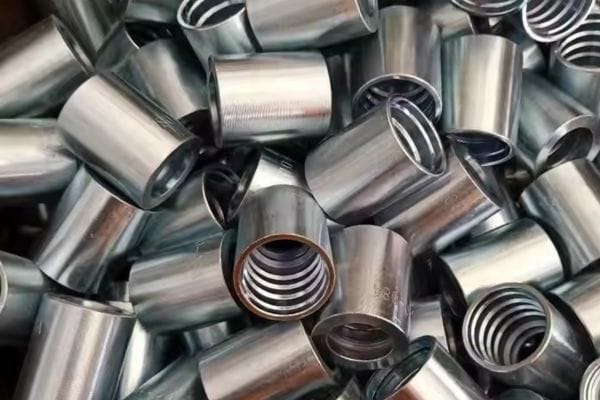
The hose ferrule plays a vital role in sealing because it acts as the outer sleeve that compresses the hose onto the fitting’s internal stem. If the hose ferrule is not crimped to the exact diameter, it cannot exert the uniform radial pressure required for a secure bond. This component is the primary safeguard against hydraulic fitting leakage.
Does Under-Crimping Compromise The Grip?
You may find yourself asking if a slightly loose ferrule is really dangerous. The reality is that the ferrule’s job is to “bite” into the wire reinforcement of the hose to provide mechanical retention. If you under-crimp by 0.1mm, those teeth may only graze the surface of the wires instead of locking onto them.
It gets worse:
- Vibrations can cause a loose ferrule to walk off the hose.
- Thermal cycling makes the rubber expand and contract, loosening the grip further.
- Pressure spikes will eventually push the fitting out of the hose.
The ferrule must be viewed as a precision instrument rather than a simple metal cap. When the crimp diameter is off by even 0.1mm, the ferrule fails to transform the hose and fitting into a single, unified component.
Can High Pressure Worsen Small Hydraulic Fitting Leakage?
High pressure significantly worsens hydraulic fitting leakage by forcing more fluid through microscopic gaps and expanding the hose material away from the fitting. As system pressure rises, any slight inaccuracy in the crimp diameter is magnified. What looks like a dry connection at idle can become a dangerous spray under full load.
Why Do Micro-Leaks Accelerate Under Load?
You might be wondering why a leak that seems small during a morning inspection suddenly becomes a disaster by noon. The truth is that pressure acts as an expander; it pushes against the inner walls of the hose, trying to find any exit. If the crimp is 0.1mm too wide, the pressure actually helps “lift” the hose material off the fitting ridges.
Here is the truth:
- Pressure pulses create a “pumping” action that pulls fluid into the gap.
- High-pressure spray can cause fluid injection injuries to nearby workers.
- Lost fluid leads to pump cavitation and system overheating.
| System State | Gap Behavior | Leak Severity |
| Static / Idle | Gap remains closed | No visible leak |
| Working Pressure | Gap opens slightly | Weeping oil |
| Peak Surge | Gap expands fully | Spray or Blow-off |
Monitoring your system under actual working loads is the only way to verify if a 0.1mm deviation is currently compromising your safety.
High pressure does not just reveal leaks; it creates them by exploiting the weaknesses left by poor crimping tolerances. Tight adherence to 0.01mm tolerances is often required to ensure that high-pressure spikes do not compromise the seal.
Why Does Material Hardness Affect Crimping Accuracy?
Material hardness affects crimping accuracy because different metals respond differently to the extreme forces applied by a crimping machine. If the fitting material is too hard, it may resist deformation, leading to a 0.1mm deviation that causes hydraulic fitting leakage. Conversely, soft materials might over-compress, leading to a weakened structure.
Can Stainless Steel Resist Proper Compression?
You might notice that stainless steel fittings are much harder to crimp than standard carbon steel. This is because stainless steel has a higher yield strength, meaning it requires more force to reach the desired final diameter. If your machine is not calibrated for the specific hardness of the fitting, you will likely end up with an under-crimped assembly.
Think about this:
- Harder materials have more “spring-back” after the dies open.
- Inconsistent material batches can lead to varying crimp diameters.
- Tooling wear is faster when working with high-hardness alloys.
Material science plays a silent but critical role in every crimp you perform. You must adjust your crimping specifications based on the specific alloy and hardness of the fitting to ensure the final diameter is perfectly within the 0.1mm tolerance window.
Is Machine Calibration Necessary To Prevent Hydraulic Fitting Leakage?
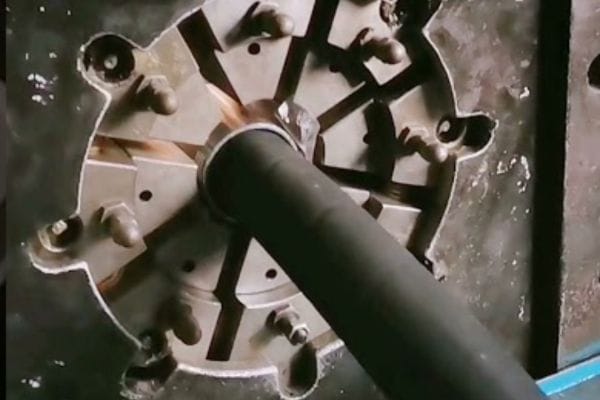
Machine calibration is absolutely necessary to prevent hydraulic fitting leakage because even the best dies can shift or wear over time. A crimper that was accurate last month might be off by 0.1mm today due to hydraulic seal wear or mechanical fatigue within the machine itself. Regular checks ensure that the “set” diameter is the “actual” diameter achieved.
How Often Should You Check Your Crimper?
You might be wondering if an annual check-up is enough for your shop equipment. The reality is that high-volume shops should verify calibration daily using a precision micrometer or “go/no-go” gauges. A tiny drift in the machine’s hydraulic pressure can result in a 0.1mm error across an entire batch of hoses.
Here is the truth:
- Dirt and debris in the die transition can affect travel distance.
- Hydraulic oil temperature in the crimper can change the press force.
- Mechanical pivot points wear down, causing inconsistent die closure.
| Check Interval | Purpose | Benefit |
| Every Shift | Verify diameter on first piece | Catches immediate drift |
| Monthly | Full mechanical inspection | Prevents long-term wear |
| Annually | Professional recalibration | Ensures NIST compliance |
Daily verification is a small price to pay compared to the cost of replacing a fleet of incorrectly assembled hydraulic hoses.
Your crimping machine is only as good as its last calibration. By implementing a strict testing protocol, you ensure that every hose leaving your bench is free from the 0.1mm deviations that cause premature failure.
How Do Thread Tolerances Impact The Final Seal?
Thread tolerances impact the final seal by ensuring that the connection between the fitting and the machine port is liquid-tight. While crimping focuses on the hose-to-fitting bond, the threads handle the fitting-to-port bond, and a 0.1mm error here can also cause hydraulic fitting leakage. Precision-cut threads are the second half of a successful hydraulic installation.
Do JIC Or NPT Fittings Require More Precision?
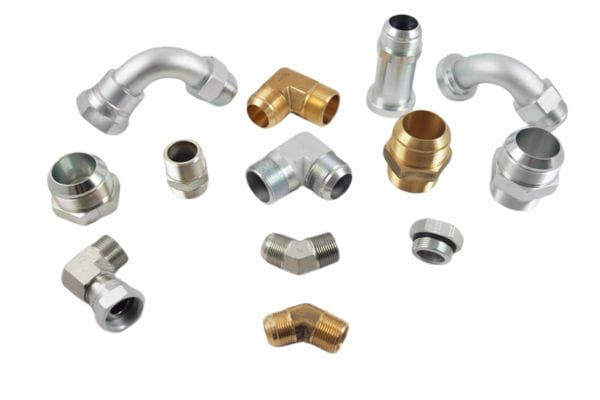
You should know that different thread types have different sealing mechanisms, with JIC hydraulic fittings relying on a 37-degree flare. If the machining of that flare is off by 0.1mm, the metal-to-metal contact will not be uniform, allowing oil to seep through. NPT threads, on the other hand, rely on thread deformation, making them even more sensitive to tiny measurement errors.
The reality is:
- JIC fittings are sensitive to surface finish and flare angle.
- NPT threads can easily “bottom out” if cut too deep.
- ORFS (O-Ring Face Seal) fittings rely on a perfectly flat surface for the seal.
| Fitting Type | Sealing Method | Precision Focus |
| JIC 37° | Metal-to-metal flare | Flare angle & finish |
| NPT / NPTF | Thread interference | Taper accuracy |
| ORFS | O-Ring compression | Surface flatness |
Precision is required at every interface, from the crimped ferrule to the threaded port, to maintain a completely dry system.
Whether you are using flare, taper, or O-ring seals, the margin for error remains razor-thin. Choosing high-quality components with verified thread tolerances is the only way to avoid leaks at the connection point.
Does Thermal Expansion Cause Hydraulic Fitting Leakage?
Thermal expansion causes hydraulic fitting leakage when the fitting and hose materials expand at different rates during operation. In a system where the crimp is already off by 0.1mm, the heat from the oil can cause the rubber to soften and “flow” away from the compression zone. This creates a gap that didn’t exist when the assembly was cold.

What Happens During Extreme Temperature Cycles?
You might be wondering why your machines only leak in the afternoon after they’ve been running for hours. Here is the truth: as the metal fitting heats up, it expands, and if the initial crimp wasn’t tight enough, that expansion can actually reduce the effective “squeeze” on the hose. In cold weather, the rubber can become brittle and shrink, further compromising a loose seal.
Consider these factors:
- Different materials (Steel vs. Rubber) have vastly different expansion coefficients.
- High-temp oil lowers the viscosity, making it easier to slip through gaps.
- Rapid cooling (shutdown in winter) can cause “cold leaks.”
| Condition | Material Response | Leak Risk (0.1mm Deviation) |
| Overheating | Rubber softens/flows | Very High |
| Freezing | Rubber shrinks/hardens | High |
| Stable (Ambient) | Materials remain at spec | Moderate |
Temperature fluctuations act as a “stress test” for your crimping quality, often revealing deviations that are invisible at room temperature.
You must account for the operating environment when performing your assemblies. A 0.1mm deviation might pass a shop test at 70°F but fail miserably in a 200°F industrial application.
Why Should You Use Matched Hose And Fitting Brands?
Using matched hose and fitting brands is essential because manufacturers design their components to work together within specific tolerance windows. Mixing a hose from one company with a fitting from another often results in a 0.1mm mismatch in the wall thickness or tail diameter. This is a leading cause of hydraulic fitting leakage in the field.
Are Universal Fittings A Risk To Reliability?
You might be tempted by the lower cost of “universal” components, but here is the truth: no fitting is truly universal. A reusable hydraulic fitting or a standard crimp fitting is engineered with a specific “bite” depth intended for a specific hose’s wire reinforcement. Using unmatched parts often leaves you with that dreaded 0.1mm gap.
Think about this:
- Hose outside diameters (OD) vary between manufacturers.
- The “tooth” profile on the fitting is optimized for specific rubber compounds.
- Warranty coverage is usually voided if you mix brands.
| Component Source | Compatibility | Reliability |
| Matched Set | Engineered fit | Maximum |
| Mixed Brands | Uncertain tolerances | Dangerous |
| Universal/Off-brand | General fitment | Low |
Stick to a single-source system to ensure that the math behind the crimp always adds up to a perfect seal.
Reliability in a hydraulic system is built on compatibility. By choosing a matched system from a trusted provider, you eliminate the guesswork and the 0.1mm errors that plague mixed-brand assemblies.
How To Detect Early Signs Of Hydraulic Fitting Leakage?
Detecting early signs of hydraulic fitting leakage requires a proactive inspection routine that looks for “weeping” before it becomes a “burst.” When a crimp is off by 0.1mm, the failure is rarely instantaneous; instead, it shows itself through small, oily residues. Training your team to spot these signs can save thousands in emergency repairs.
Is Oil Weeping A Sign Of Impending Failure?
You should never ignore a “wet” fitting, even if the machine is still working fine. Here is the truth: oil weeping at the junction of the hose and ferrule is the primary indicator that the internal seal has been compromised by a 0.1mm deviation. Once the oil has reached the outer cover, the internal structure of the hose is already failing.
Look for these red flags:
- Dust and dirt sticking to the hose ends (indicating oil residue).
- Blistering or bubbling on the hose cover near the fitting.
- A drop in system pressure or unusual pump noise.
| Visual Sign | Meaning | Required Action |
| “Sweating” | Microscopic leak starting | Monitor closely |
| Accumulating Drip | Seal is failing | Replace immediately |
| Cover Blister | Internal tube burst | Shut down machine |
Spotting a leak early is the difference between a 30-minute maintenance task and a week of unplanned downtime.
Early detection is your last line of defense against the 0.1mm deviation. By inspecting your fittings weekly, you can catch the subtle signs of leakage before they turn into a catastrophic environmental spill or operator injury. For more information on high-precision hydraulic solutions or to get a quote on matched hose and fitting sets, please contact us today.
FAQ
Can I fix a leaking fitting by crimping it again?
No, you should never “double-crimp” a fitting. This is because the initial crimp has already work-hardened the metal and potentially damaged the hose’s internal wire structure; a second crimp will likely cause the fitting to crack or the hose to burst.
What’s the best tool for checking crimp diameter?
A calibrated digital micrometer is the best tool for this job. It provides the high-precision readings necessary to detect the 0.1mm deviations that standard tape measures or cheap calipers will miss.
Can a 0.1mm error cause a hose to blow off?
Yes, it certainly can. In high-pressure systems, that 0.1mm gap reduces the mechanical grip on the wire reinforcement, allowing the pressure to literally push the fitting out of the hose.
Does a 0.1mm deviation affect the hose’s life span?
Absolutely. Even if it doesn’t leak immediately, a deviation causes uneven stress on the hose’s inner tube and reinforcement, leading to premature fatigue and failure.
Is it safe to use a hose that is “weeping” slightly?
No, a weeping hose is a failing hose. It indicates that the primary seal is gone, and at any moment, the high-pressure fluid could tear through the remaining material.