Identifying hidden costs in hydraulic fittings requires a deep dive into component longevity beyond the initial purchase price to prevent systemic budget failures. While a cheaper fitting saves pennies today, it often triggers catastrophic seal degradation or thread galling that necessitates premature system overhauls.
Imagine your primary production line grinding to a halt because a $5 fitting failed during a peak shift. This isn’t just a minor mechanical hiccup; it’s a cascading financial disaster involving lost labor hours, missed delivery deadlines, and potential safety liabilities. By prioritizing precision-engineered connectors and proactive material selection, you can eliminate these volatile variables and secure your operational budget against the invisible erosion of “budget-friendly” parts.
Why Do Cheap Hydraulic Fittings Fail Prematurely?
Cheap hydraulic fittings fail prematurely because they often utilize inferior base metals and inconsistent machining tolerances that cannot withstand high-pressure fluctuations. When a fitting isn’t manufactured to exact specifications, the mating surfaces fail to create a perfect seal, leading to turbulence and heat generation. The internal geometry of low-end components often harbors burrs or rough finishes that catch debris, accelerating the wear on your entire hydraulic circuit.
- Inconsistent plating thickness leading to rapid oxidation and thread seizure.
- Poor annealing processes that make the metal brittle under thermal cycling.
- Dimensional variances that cause over-tightening and cracked nut assemblies.

Is Material Quality The Main Culprit?
Material quality is indeed the primary factor because sub-standard alloys lack the fatigue resistance required for heavy-duty OEM applications. If the carbon content is off by even a fraction, the fitting may crack under the constant “hammering” of hydraulic pulses. You might be wondering if there is a way to spot this before installation, but often the chemistry remains hidden until the system is under full load.
Using certified 316 stainless steel or high-grade carbon steel with specialized coatings prevents the electrochemical reactions that lead to “weeping” joints. By investing in materials tested for salt spray resistance and burst pressure, you protect the integrity of the fluid path and the safety of your operators.
| Material Property | Low-Cost Fitting | Topa Premium Fitting |
| Corrosion Resistance | < 72 Hours Salt Spray | > 720 Hours Salt Spray |
| Thread Precision | Class 2A/2B Loose | Class 3A/3B Precision |
| Burst Pressure Rating | 3x Working Pressure | 4x Working Pressure |
Selecting components with documented metallurgical tracing ensures that every joint in your system can handle the rigorous demands of industrial environments.
How Do Micro-Leaks Drain Your Operational Budget?
Micro-leaks drain your budget by causing a continuous loss of expensive hydraulic fluid and increasing the energy consumption required to maintain system pressure. A single drop of oil per second translates into hundreds of gallons lost annually, creating environmental hazards and slip-and-fall risks. But here’s the kicker… the cost of the lost fluid is often dwarfed by the cost of the labor required to constantly top off the reservoir and clean the machinery.
- Increased electricity costs as pumps work harder to compensate for pressure drops.
- Higher expenses for absorbent materials and hazardous waste disposal services.
- Decreased cooling efficiency as aerated oil loses its heat-transfer properties.
Can Small Drips Lead To Major Component Failure?
Small drips are the early warning signs of internal seal erosion that can eventually lead to pump cavitation and valve sticking. When fluid escapes, air and moisture often enter the system, leading to oil oxidation and the formation of harmful sludge. Fixing these leaks early prevents the “sandpaper effect” where contaminated oil grinds down expensive cylinder walls and pistons.
Maintaining a dry system through tight-tolerance hydraulic fittings is the most effective way to extend the life of your hydraulic pumps. This proactive approach eliminates the need for emergency oil shipments and reduces the frequency of expensive filter replacements.
What Is The Real Cost Of Installation Errors?
The real cost of installation errors lies in the immediate damage to thread profiles and the subsequent risk of high-pressure blowouts during operation. Over-torquing a hydraulic fittings assembly can stretch the nut or crush the flare, making it impossible to achieve a reliable seal without replacing the entire unit. This is where it gets interesting… many technicians “tweak” a leaking fitting by tightening it further, which actually worsens the deformation and guarantees a future failure.
- Cost of replacement parts ruined during the initial assembly phase.
- Lost production time while waiting for specialized tools or technicians.
- Potential for catastrophic injury if a weakened fitting fails under load.
Are Specialized Tools Necessary For Proper Sealing?
Using calibrated torque wrenches and thread identification kits is essential to avoid the “guesswork” that leads to most field failures. Without the correct tools, it is nearly impossible to hit the precise “flats from wrench tight” (FFWR) requirements for various fitting styles. Believe it or not, most “hidden costs” in maintenance are actually the result of improper training or the use of worn-out wrenches on soft metal surfaces.
Standardizing your assembly process with clear torque charts and go/no-go gauges ensures that every connection is validated before the system is pressurized. This rigor reduces rework and ensures that your equipment leaves the shop with a factory-level seal that lasts for years.
| Error Type | Immediate Consequence | Long-Term Financial Impact |
| Over-Torquing | Cracked Nut / Flared End | Unexpected Blowout / Injury |
| Under-Torquing | Vibration Loosening | Chronic Leaking / Oil Loss |
| Crossed Threads | Damaged Port | Expensive Manifold Replacement |
Implementing a standardized installation protocol prevents the expensive cycle of “fix-and-fail” that plagues unmanaged hydraulic maintenance programs.
Why Does Vibration Fatigue Lead To Costly Downtime?
Vibration fatigue causes hydraulic fittings to develop microscopic stress cracks that eventually propagate into full structural failures without warning. In mobile equipment or high-cycle industrial presses, constant harmonic resonance acts like a slow-motion saw on metal-to-metal connections. Here’s the deal: if your fittings are not properly supported or if they are made from low-fatigue alloys, they will eventually snap at the highest point of stress.
- Unscheduled downtime during peak operational windows.
- Damage to adjacent electrical or pneumatic lines during a high-pressure burst.
- Need for specialized “emergency” shipping of replacement components.
How Can You Dampen Vibration To Protect Fittings?

Integrating proper hose clamps and vibration-dampening brackets is the best way to isolate your fittings from the destructive forces of mechanical movement. Furthermore, using “O-ring Face Seal” (ORFS) fittings can provide a more resilient connection that absorbs slight misalignments better than rigid JIC flares. It gets better, as these resilient seals act as a buffer, preventing the metal-on-metal “chatter” that leads to thread galling and port damage.
Monitoring system harmonics and installing flexible hose jumpers where vibration is highest can save thousands in cracked manifold repairs. This engineering-first mindset ensures that your hydraulic adapters remain secure even in the most punishing off-road or industrial environments.
| Vibration Source | Effect on Fitting | Recommended Mitigation |
| Engine Resonance | Thread Loosening | Loctite / Nord-Lock Washers |
| Hydraulic Shock | Metal Fatigue / Cracking | Accumulators / Pulse Dampeners |
| Mechanical Impact | Structural Deformation | Protective Guarding / Heavy-Wall Fittings |
Reducing mechanical stress on your connectors prevents the sudden, “silent” failures that often result in the most expensive emergency repair bills.
Is Corrosion The Invisible Enemy Of Your Budget?
Corrosion is the invisible enemy because it eats away at the protective plating of hydraulic fittings, eventually compromising the structural wall thickness of the part. Once the base metal is exposed to salt, moisture, or chemicals, the rust can migrate into the threads, making it impossible to remove the fitting without damaging the manifold. By the time you see red rust on the outside, the internal sealing surface may already be pitted and compromised.
- Difficulty in performing routine maintenance due to “frozen” or rusted joints.
- Contamination of hydraulic oil by rust particles, leading to valve damage.
- Reduced aesthetic value of the machinery, impacting resale or professional image.
Which Coatings Offer The Best Financial Return?
Investing in Zinc-Nickel (ZnNi) coatings provides significantly better protection than standard clear zinc, often lasting ten times longer in harsh environments. While the upfront cost is slightly higher, the “cost per hour of service” drops dramatically because you aren’t replacing rusted parts every season. You might be wondering if it’s worth the switch, and the answer lies in the labor hours saved during your next scheduled overhaul.
Choosing the right finish for your specific environment—whether it’s marine, agricultural, or chemical—ensures that your fittings remain serviceable for the life of the machine. This prevents the nightmare scenario of having to drill out a snapped fitting from an expensive hydraulic block.
| Coating Type | Salt Spray Hours | Ideal Application |
| Zinc Plating (Cr3) | 72 – 120 | Indoor / Dry Storage |
| Zinc-Nickel (ZnNi) | 720 – 1000 | Coastal / Road Salt |
| Stainless Steel | 2000+ | Chemical / Food Grade |
Prioritizing advanced surface treatments eliminates the labor-intensive “torch and hammer” repairs necessitated by low-grade, corrosive-prone components.
How Does Poor Inventory Management Increase Costs?
Poor inventory management increases costs by forcing “panic buying” of hydraulic fittings at retail prices when a critical machine goes down. If you don’t have the right thread pitch or size on the shelf, you pay for overnight shipping and lose hours of production waiting for the courier. But here’s the kicker… many shops end up “making do” with incorrect adapters, which creates a new leak point and restarts the failure cycle.
- High costs of expedited shipping and emergency procurement fees.
- Overstocking of “useless” sizes while critical parts are frequently out of stock.
- Increased administrative burden of managing dozens of small, sporadic orders.
Can VMI Programs Save You Money?
Vendor Managed Inventory (VMI) ensures that your most critical standard hydraulic fittings are always in stock, reducing the administrative overhead of manual ordering. By partnering with a reliable supplier, you can shift the burden of stock tracking to professionals who understand your consumption patterns. This move transforms your procurement from a reactive “firefighting” mode into a streamlined, predictable business process.
A well-organized bin system with clear labeling and “re-order” points prevents the chaos of searching through greasy boxes for a single JIC nut. This organization speeds up repairs and ensures that your technicians always have the “right tool for the job.”
What Happens When You Mix Different Fitting Standards?
Mixing different fitting standards, such as forcing a Metric thread into a BSPP port, leads to immediate thread destruction and high-pressure leaks. Even when threads “feel” like they fit, slight differences in pitch or angle can cause the metal to gall, permanently damaging the expensive equipment ports. This is where it gets interesting… many “hidden costs” come from the time spent trying to identify whether a fitting is JIC, SAE, or DIN in the middle of a field repair.
- Risk of thread stripping and catastrophic fitting ejection under pressure.
- Increased complexity in training for maintenance staff.
- Need for an excessive number of conversion adapters, which create more leak points.
Why Is Standardizing Your Fleet Important?
Standardizing your equipment to use a single family of hydraulic fittings reduces the variety of spares you need to carry and minimizes the chance of technician error. If every machine in your fleet uses ORFS connections, your team becomes experts at that specific assembly method, drastically reducing the rate of installation mistakes. You might be wondering how to start this transition, and it usually begins with a comprehensive audit of your most frequent failure points.
| Thread Standard | Region / Usage | Sealing Method |
| JIC (37° Flare) | North America | Metal-to-Metal |
| ORFS | Heavy OEM / High Vibration | O-Ring / Flat Face |
| BSPP / BSPT | Europe / UK | Tapered or Gasket |
Eliminating the confusion of mismatched standards protects your equipment’s manifolds and ensures that every repair is performed to the correct specification.
Are High-Pressure Surges Killing Your Connectors?
High-pressure surges, often called “hydraulic shock,” can exceed the rated burst pressure of standard hydraulic fittings, leading to cracked bodies and blown seals. These spikes happen in milliseconds when a valve is slammed shut or a heavy load is suddenly dropped, sending a “sonic boom” through the fluid. Believe it or not, these surges can be several times higher than the pump’s relief valve setting, punishing every joint in the system.
- Fatigue failure of the fitting “nose” or flare.
- Extrusion of O-rings out of their grooves, causing instant leaks.
- Damage to sensitive gauges and sensors located near the surge point.
How Do You Protect Against Pressure Spikes?
Installing hydraulic accumulators or “soft-shift” valves can absorb the energy of a surge before it reaches your high-pressure fittings. Furthermore, selecting fittings with a higher “design factor” (e.g., a 4:1 burst-to-working pressure ratio) provides a safety margin that can withstand these inevitable operational glitches. It gets better, as these protective measures not only save your fittings but also extend the life of your expensive pumps and cylinders.
Monitoring your system with high-speed digital transducers can help identify where these “hidden” spikes are occurring. Once identified, you can re-engineer the circuit to be more “forgiving,” saving you thousands in long-term component costs.
| System Event | Pressure Spike | Potential Damage |
| Rapid Valve Close | Up to 5x Normal | Cracked Fitting Body |
| Cylinder Bottoming Out | 2x – 3x Normal | Blown O-Rings |
| Pump Start-up | 1.5x Normal | Gradual Fatigue |
Designing your system to manage fluid momentum prevents the violent pressure shocks that “quietly” destroy your hydraulic infrastructure over time.
Does Using The Wrong Seal Material Cost You More?
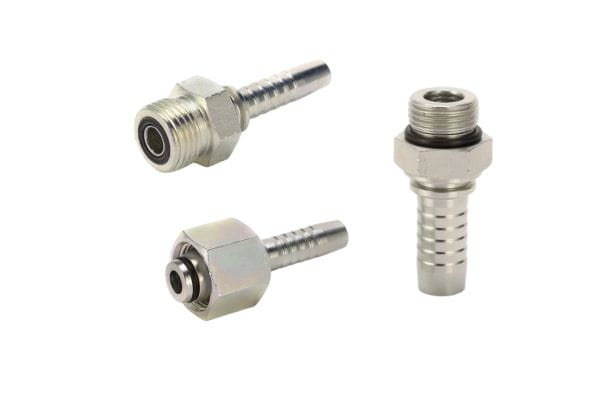
Using a seal material that is incompatible with your hydraulic fluid or operating temperature will cause the hydraulic fittings to leak almost immediately. For example, using standard Nitrile (Buna-N) O-rings in a high-temperature phosphate ester system will cause the seals to swell, soften, and eventually disintegrate. The O-ring itself costs cents, but the cost to strip down a machine to replace a 50-cent seal can be thousands of dollars.
- Chemical degradation of seals leading to “sticky” or “gummy” oil.
- Hardening of seals in cold environments, leading to “weeping” upon start-up.
- Contamination of the fluid system with seal fragments.
Why Is Temperature Range So Critical?
Operating outside the rated temperature of your seal material causes it to lose its “elastic memory,” meaning it can no longer spring back to fill the gaps in the fitting. In extreme heat, seals become brittle and crack; in extreme cold, they turn into hard plastic that can’t seal against vibration. You might be wondering if there is a “universal” seal, and while Viton (FKM) comes close, it requires careful selection based on your specific chemical environment.
Matching your seal chemistry to your specific fluid—whether it’s mineral oil, water-glycol, or synthetic—is the most cost-effective way to prevent “ghost leaks.” This attention to detail ensures your connections remain bone-dry regardless of the environmental extremes.
| Seal Material | Temp Range (°F) | Fluid Compatibility |
| Nitrile (Buna-N) | -40 to +250 | Standard Mineral Oil |
| Viton (FKM) | -15 to +400 | Synthetic / High Temp |
| EPDM | -65 to +300 | Skydrol / Brake Fluid |
Proper seal selection is a tiny investment that pays massive dividends by preventing the labor-intensive rework associated with premature seal failure.
Can A Reliable Supplier Relationship Reduce Hidden Costs?
A reliable supplier relationship reduces hidden costs by providing technical expertise and high-quality hydraulic fittings that are tested for real-world B2B applications. Instead of just “taking an order,” a professional partner helps you identify the root causes of frequent failures and suggests better material or design alternatives. The most expensive supplier is the one who provides inconsistent parts that fail in the field, regardless of how low their invoice price is.
- Access to engineering support for troubleshooting complex system leaks.
- Guaranteed consistency in machining and plating across every batch.
- Long-term price stability and priority during global supply chain disruptions.
What Should You Look For In A Professional Partner?
You should look for a supplier that maintains strict ISO certifications and offers transparent material traceability for all their hydraulic hose connectors. A partner who understands the high stakes of North American OEM and distributor requirements will provide the documentation and quality assurance you need to protect your brand. When you find a supplier that prioritizes your uptime, your maintenance budget finally becomes predictable.
By moving away from “commodity” buying and toward “strategic” sourcing, you eliminate the variability that causes most hydraulic budget overruns. This partnership allows you to focus on your core business while the experts handle the integrity of your fluid power connections.
| Supplier Quality | Procurement Style | Business Impact |
| Low (Auction/Spot) | Price-Focused | High Volatility / Frequent Failure |
| Medium (Generalist) | Availability-Focused | Average Reliability / Hidden Costs |
| High (Specialist) | Value-Focused | High Uptime / Lowest Total Cost |
Building a bridge with a high-caliber manufacturer ensures that your “hidden costs” are identified and eliminated before they ever reach your production floor.
Conclusion
Addressing these hidden costs transforms your hydraulic system from a liability into a high-performance asset. By focusing on material integrity, precise installation, and strategic sourcing, you can effectively “plug the leaks” in your maintenance budget. We’ve seen how micro-leaks, vibration, and poor inventory management can erode your bottom line, but we’ve also provided the roadmap to fix them. Our goal is to empower you to make informed decisions that prioritize long-term machine health over short-term savings. If you are ready to stabilize your operations and eliminate unscheduled downtime, contact us today .
FAQ
Q1: Can I use PTFE tape on all hydraulic fittings to stop leaks?
No, you should never use PTFE tape on flared or O-ring style fittings. It is only intended for NPT (Pipe) threads and can actually cause leaks or system contamination if pieces of tape break off into the fluid stream.
Q2: What’s the best way to identify an unknown thread in the field?
The most reliable method is using a thread pitch gauge and a pair of calipers to measure the outside diameter. Comparing these measurements to a standard thread chart is the only way to be 100% sure of a match.
Q3: How do I know if my fittings are failing due to vibration?
Look for “shiny” spots on the metal where the fitting meets the port, or check for fine, reddish-brown dust around the threads. These are signs of “fretting,” which indicates the fitting is moving under load and will eventually crack.
Q4: Can I reuse hydraulic fittings after they have been disassembled?
It depends on the type. O-ring Face Seal fittings can often be reused if the seal is replaced, but JIC flare fittings can only be tightened a few times before the metal becomes too deformed to seal properly.
Q5: How do I choose between stainless steel and carbon steel fittings?
Standardize on carbon steel for indoor, dry environments to save costs. Switch to stainless steel only when the fittings are exposed to corrosive chemicals, salt air, or extreme temperatures that exceed the limits of protective plating.