Hydraulic fittings fail during installation primarily due to excessive torque, material flaws, thread mismatches, and severe component misalignment that overload the metal’s structural tolerance. Imagine a busy maintenance facility where an industrial machine goes down during a critical production run. The technician rushes to swap out a failing component, but as the final connection is tightened, a sharp, metallic pop echoes through the shop. A closer look reveals a hairline fracture stretching across the newly installed sleeve, instantly causing fluid to weep. This scenario is a classic example of an installation failure that leads to unexpected downtime and safety hazards. Fortunately, understanding the root engineering causes of a hydraulic fittings crack allows operators to optimize assembly procedures, prevent component stress, and maintain leak-free system integrity.
Why Do Hydraulic Fittings Fail During High-Pressure Installation?
High-pressure fittings break during assembly because excessive mechanical preload forces combine with structural stress concentrations to exceed the yield strength of the alloy. When components are forced into place under improper conditions, the material undergoes severe plastic deformation.

Understanding Preload Stress Concentrations
Mechanical preload must remain within strict elastic limits to guarantee reliable joint sealing. When a technician exceeds these limits, the tensile stress spikes drastically at the first engaged thread root.
The stress distribution is never perfectly uniform across the component body.
- Localized shearing forces deform the thread profile.
- Hairline cracks propagate along the grain boundaries of the steel.
- Micro-voids coalesce into macro-fractures under minimal operational shock.
Recognizing Warning Signs of Material Overstress
Field technicians must watch for subtle physical changes during the tightening sequence to prevent catastrophic rupture. A sudden, unexplained drop in resistance while turning the wrench indicates that the material has reached its ultimate tensile strength.
Continued tightening beyond this point ensures structural failure. This rapid degradation requires immediate replacement rather than operational testing.
| Failure Indicator | Structural Cause | Field Observation |
| Resistance Drop | Yield Point Exceeded | Wrench spins freely without torque increase |
| Visible Distortion | Plastic Deformation | Fitting body shows asymmetrical elongation |
| Surface Whitening | Micro-fracturing | Plating layer flakes off near stress zones |
How Does Over-Torque Direct Mechanical Failure in Tapered Threads?
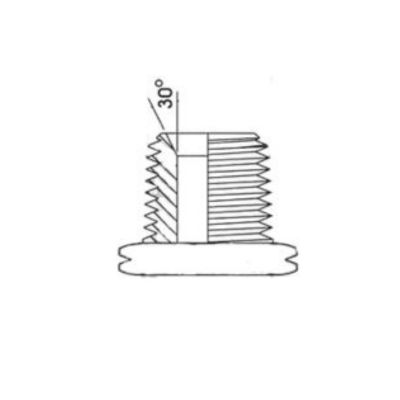
Over-torque causes direct failure in tapered threads by generating extreme radial expansion forces that split the female port or the male fitting body along its longitudinal axis. Tapered threads seal by metal-to-metal wedge contact, which naturally multiplies assembly forces.
Exceeding the specified torque specifications converts rotational effort into destructive outward pressure. Utilizing a standard hydraulic fittings crack diagnostic procedure reveals that over-tightening is the leading cause of component replacement in mobile machinery.
The Mechanics of Radial Expansion Failure
Tapered designs rely on a wedge action that increases interference as the joint is tightened. If the torque is unchecked, this interference generates hoop stresses that quickly surpass the tensile capabilities of the housing.
The physical stress behaves like a hydraulic wedge splitting wood.
- Radial forces concentrate at the deepest point of thread engagement.
- The material undergoes localized necking along the stress plane.
- A clean, longitudinal split develops across the hex flats.
Why Lubrication Minimizes Friction Variables
Dry threads exhibit high friction coefficients that trick technicians into applying improper torque values. Introducing a compatible lubricant stabilizes the torque-to-tension ratio, ensuring that rotational force is converted into proper sealing depth rather than destructive stress.
Proper lubrication prevents thread galling during high-pressure seat engagement. This simple step protects complex manifold ports from irreversible structural splitting.
| Thread Condition | Coefficient of Friction | Risk of Wedge Splitting |
| Dry Carbon Steel | 0.15 – 0.18 | Critical expansion stress accumulation |
| Lightly Lubricated | 0.10 – 0.12 | Controlled seating with uniform hoop stress |
| Over-Lubricated | 0.06 – 0.08 | High risk of accidental over-torque |
What Role Does Material Inconsistency Play in Split Flare Ends?
Material inconsistency causes split flare ends when low-ductility alloys or sub-surface metallurgical inclusions fail to survive the severe geometric expansion required during the flaring process. When a fitting sleeve or tube end is formed, the metal must flow smoothly without localized thinning.
If the raw material contains impurities or suffers from improper heat treatment, the grain structure separates under tension. Addressing a hydraulic fittings crack in flare connections requires verifying the metallurgical purity of the component batch before high-volume deployment.
Metallurgical Flaws and Grain Separation
Sub-surface inclusions like oxides or sulfides act as internal stress risers within the cold-worked steel matrix. During expansion, these impurities prevent uniform stress distribution, causing the grain structure to rip apart along the flare perimeter.
The underlying metallurgy dictates the component’s structural limits.
- Non-metallic inclusions disrupt the continuity of the alloy matrix.
- Hydrogen pockets formed during manufacturing embrittle the grain boundaries.
- Micro-cracks initiate at the zone of maximum geometric expansion.
Identifying Ductility Deficiencies in Cold-Worked Fittings
Low ductility prevents the metal from stretching smoothly when compressed against the mating seat. If the alloy is too hard, the cold-working process induces high residual stresses that manifest as immediate fractures during wrench installation.
A lack of uniform elongation properties leads to predictable field splitting. This mechanical reality shifts the burden of quality control to rigorous batch hardness testing.
| Metallurgical Property | Optimal Specification | Impact of Deficiency |
| Elongation Rate | Minimum 20% | Sharp perimeter cracking during mechanical seat compression |
| Hardness Range | 70 – 80 HRB | High brittle-fracture sensitivity under dynamic vibration |
| Inclusion Content | ASTM E45 Method A | Accelerated fatigue propagation across the sealing face |
How Do Mismatched Thread Dimensions Induce Stress Fractures?
Mismatched thread dimensions induce stress fractures by concentrating the entire installation load onto a single thread ridge rather than distributing it evenly across the full length of engagement. When an operator attempts to force incompatible thread profiles together, the geometric interference generates localized shear stresses.
This artificial resistance mimics the feel of a tight joint, prompting the technician to apply more force to achieve a seal. Using an analytical approach to identify a hydraulic fittings crack reveals that combining metric and imperial threads quickly destroys core mechanical profiles.

Thread Profile Interference Dynamics
Forcing a non-compatible male and female connection together alters the load path of the joint entirely. The mismatched pitch forces the apex of the thread to dig directly into the opposing root, creating a severe stress riser.
- Mismatched pitches prevent uniform axial advancement during rotation.
- High spot contact zones reach yield temperatures due to localized friction.
- Crest-to-root interference initiates micro-fractures at the base of the ridge.
Using calibrated thread gauges during sorting completely mitigates this systemic installation error.
Why Force Multipliers Accelerate Thread Shear
Technicians often use extended cheater bars to overcome the initial resistance caused by dimension mismatches. This artificial torque multiplier delivers excessive axial force that shears the engaged threads off the core body, leading to immediate fracture.
The excessive mechanical advantage destroys the base material’s shear plane. This structural failure requires a complete component replacement to ensure future operational safety.
| Mismatch Type | Contact Mechanism | Primary Fracture Location |
| Metric vs. BSPP | Pitch crest interference | First engaged thread root profile |
| JIC vs. SAE ORB | Angle seating mismatch | Port shoulder and seal seat perimeter |
| NPTF vs. Metric Taper | Lead variation binding | Mid-body longitudinal hex split line |
Why Does Improper Component Alignment Cause Fitting Body Fractures?
Improper component alignment causes fitting body fractures by introducing severe bending moments and asymmetric shear loads that stress one side of the component beyond its structural limits. Hydraulic connections are designed to handle pure axial tension to compress the internal sealing elements safely.
When rigid tubing or heavy hoses are pulled into place at an angle, the resulting side load creates an uncompensated leverage arm. This constant mechanical strain predisposes the fitting to snap at the junction between the hex body and the first thread.
The Physics of Uncompensated Bending Moments
An offset connection converts standard assembly torque into a destructive lateral leverage arm that strains the metal matrix asymmetrically. The side of the fitting facing the misalignment undergoes extreme tension, while the opposite side experiences high compression.
This structural imbalance creates a permanent path for fracture propagation.
- Misaligned hose routing pulls the fitting head away from its centerline.
- The asymmetrical stress profile concentrates at the weakest wall section.
- Micro-fissures open on the tension side during the final torque sequence.
Ensuring that hoses hang naturally before tightening eliminates these destructive bending stresses.
Mitigating Side Load Stress with Flexible Routings
Rigid pipe installations require precise multi-axis alignment to avoid preloading the connection joints destructively. Utilizing short segments of flexible hose or integrating swivel adapters allows the system to accommodate geometric variations without transferring structural strain to the fitting bodies.
Providing physical allowance for movement prevents rigid stress accumulation. This engineering practice shifts the operational load from the structural metal to the flexible elastomer.
| Alignment Offset | Induced Bending Stress | Structural Failure Risk |
| Less than 0.5 mm | Within safe elastic margin | Nominal component service lifecycle |
| 0.5 mm to 1.5 mm | Accelerated fatigue buildup | Hairline fracture initiation at hex base |
| Greater than 1.5 mm | Immediate plastic yield | Component body snap during wrench torque |
What Structural Damage Occurs from Reusing Damaged Hydraulic Fittings?
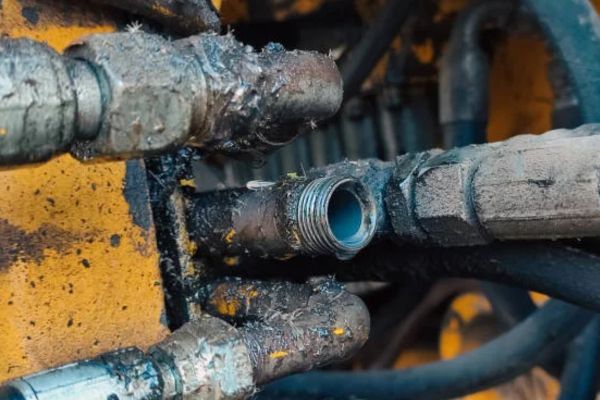
Reusing damaged hydraulic fittings causes severe structural damage by re-stressing material that has already undergone work hardening, thread stretching, or localized geometric distortion during its initial installation lifecycle. Once a high-pressure fitting is torqued to its seat, the metal yields slightly to conform to the mating surface and create a positive seal.
Attempting to reinstall this component forces the pre-deformed threads into a secondary compression cycle, accelerating micro-structural fatigue and initiating stress-corrosion fractures. Inspecting used components with clear rejection criteria prevents the accidental deployment of structurally compromised hardware.
The Phenomenon of Thread Stretching and Fatigue
Repeated torque applications stretch the core pitch of the male fitting permanently, altering the geometry of the thread engagement zone. This deformation prevents the thread profiles from interleaving correctly during secondary assembly, causing the entire installation load to lock onto the crests.
- Initial assembly stretches the thread pitch beyond its elastic limit.
- Reinstallation forces the deformed ridges to bind inside the port mating zone.
- The resulting localized stress concentration initiates immediate base cracking.
Why Material Fatigue Limits Sealing Re-engagement
Work-hardened metal exhibits high brittleness and a reduced capacity to absorb operational pressure spikes without structural failure. When a deformed fitting is forced to seat a second time, the lack of material compliance leads to immediate fracturing along the sealing flank.
The metal loses its original plastic compliance characteristics. This loss requires procurement teams to prioritize fresh components over salvaged hardware.
| Component Status | Structural Yield Margin | Micro-Crack Sensitivity |
| Virgin Steel | 100% Nominal Elastic Range | Minimum; high energy absorption capacity |
| Single Re-use | Reduced by 40% due to stretch | Moderate; localized deformation zones present |
| Multiple Re-use | Exhausted; material is brittle | Critical; immediate fracture risk under torque |
Adhering to a standardized inspection sequence ensures that fluid delivery systems achieve long-term operational reliability without experiencing stress-induced component separation. Following these rigorous steps ensures that assembly teams maximize overall asset uptime. If you encounter unexpected joint performance anomalies or require detailed layout integration support during complex system design phases, please feel free to contact us today to connect with our senior application engineering team for a full technical consultation.
FAQ
Can I reuse a hydraulic fitting if the threads look clean?
No, you should avoid reusing high-pressure hydraulic fittings even if they appear undamaged to the naked eye. Clean threads can still harbor permanent elongation and material fatigue from their previous torque cycle, which prevents them from distributing installation loads evenly during reassembly and often leads to sudden stress fractures.
What is the best way to prevent over-torque failures during field installation?
The best method is to always use a calibrated torque wrench combined with the manufacturer’s specific torque charts for the exact fitting material and size. If a torque wrench is unavailable, utilizing the “Flats From Finger Tight” method provides a structured geometric guideline that minimizes human guesswork and reduces the risk of splitting the component body.
How do I know if a fitting cracked due to material defect or installer error?
You can determine the root cause by performing a detailed fracture analysis on the failed component. Clean, longitudinal splits along the hex body with stretched thread profiles point directly to installer over-torque, whereas circumferential cracks showing no material distortion or thread deformation typically indicate ductility deficiencies, subsurface inclusions, or hydrogen embrittlement from manufacturing flaws.
Can I apply standard thread sealants to tapered hydraulic connections?
Yes, you can use specialized anaerobic hydraulic sealants on tapered threads, but you must adjust your installation torque values to compensate for the reduced friction. Anaerobic sealants act as powerful lubricants during assembly, meaning standard dry torque specifications will generate excessive radial wedge forces that can easily split the female port housing.
How do I know if my rigid tubing alignment is causing excessive fitting stress?
You can verify alignment stress by unbolting the fitting joint and observing whether the tube end springs away from the port centerline. If the rigid line shifts laterally or opens a visible gap greater than 0.5 millimeters without manual assistance, the system suffers from severe misalignment that will introduce destructive bending moments once torqued back into place.