
The origin of the camlock fitting is rooted in the MIL-C-27487 military specification, designed to provide the United States Armed Forces with a rugged, standardized, and reliable method for fuel and water transfer in field conditions. The fundamental design objective was “interchangeability”—ensuring that any male adapter would fit any female coupler of the same size, regardless of the manufacturer.
In modern industrial contexts, the military specification has been superseded by the A-A-59326A federal standard in the United States and the EN 14420-7 standard in Europe. The core value proposition of camlock fittings remains their efficiency: the “cam action” mechanical principle allows for a secure, leak-proof seal achieved in seconds, significantly reducing downtime compared to threaded or flanged connections.
Anatomy and Component Analysis
The integrity of a cam and groove coupling depends on the precision engineering of four primary components: the body, the cam arms, the pins, and the gasket.

The Body (Coupler and Adapter)
The body is divided into the female coupler and the male adapter. These are manufactured via two primary methods:
- Investment Casting: Typically used for stainless steel, providing superior dimensional accuracy and surface finish.
- Die Casting: Common for aluminum and brass, offering high production efficiency and structural consistency.
Cam Arms (Levers)
The cam arms are the mechanical heart of the coupling. When closed, they exert downward pressure on the male adapter’s groove. High-quality fittings utilize 316 Stainless Steel or forged brass for cam arms to prevent “ear elongation” or stress fracturing under high-cycle use.
Pins and Rings
The pins act as the pivot point for the cam arms. They must be manufactured from high-tensile materials (typically 304 or 316 stainless steel) to withstand the shear forces generated during the locking process. Pull rings are attached to the arms to facilitate manual operation.
The Gasket
The gasket is the only component that creates the actual fluid seal. It sits within a recessed groove in the female coupler. The selection of gasket material is perhaps the most critical engineering decision in the assembly, as it must be chemically compatible with the media and capable of maintaining elasticity under specific temperature ranges.
Working Principle: How Do Camlock Fittings Work
The functionality of a camlock fitting is based on mechanical leverage and axial compression.

- Insertion: The male adapter is inserted into the female coupler until it makes contact with the gasket.
- Engagement: The operator rotates the cam arms downward.
- Compression: As the arms rotate, the eccentric cam profile (the “cam”) engages with the circumferential groove on the male adapter. This pulls the adapter deeper into the coupler, compressing the gasket.
- Locking: Once the arms are fully closed, the geometry of the cam ensures the connection is self-locking under normal operating conditions.
Note: Mechanical vibration or pressure surges can theoretically dislodge cam arms. Therefore, technical protocols mandate the use of safety pins (R-clips) or automatic locking handles in high-risk applications.
Comprehensive Type Guide and Compatibility
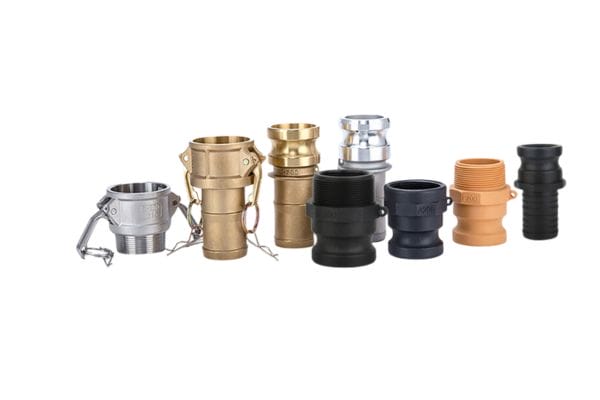
Standardization allows for modularity. Camlock fittings are categorized by “Types,” which define the connection interface at the back of the coupling (threaded, barbed, or capped).
Technical Classification of Types
| Type | Description | Primary Application |
| Type A | Male Adapter x Female NPT/BSP Thread | Adapting threaded pipe to a camlock interface. |
| Type B | Female Coupler x Male NPT/BSP Thread | Connecting a hose to a threaded pump outlet. |
| Type C | Female Coupler x Hose Shank (Barbed) | Direct insertion into industrial hoses; secured with clamps. |
| Type D | Female Coupler x Female NPT/BSP Thread | Mounting onto threaded pipe ends. |
| Type E | Male Adapter x Hose Shank (Barbed) | Standard male hose-end connection. |
| Type F | Male Adapter x Male NPT/BSP Thread | Adapting threaded manifolds to male camlock points. |
| Type DC | Dust Cap (Female Coupler) | Sealing and protecting male adapters when not in use. |
| Type DP | Dust Plug (Male Adapter) | Sealing and protecting female couplers when not in use. |
Compatibility Matrix
The following table illustrates the permissible mating pairs for standard industrial configurations:
| Adapter (A) | Adapter (E) | Adapter (F) | Dust Plug (DP) | |
| Coupler (B) | Yes | Yes | Yes | Yes |
| Coupler (C) | Yes | Yes | Yes | Yes |
| Coupler (D) | Yes | Yes | Yes | Yes |
| Dust Cap (DC) | Yes | Yes | Yes | N/A |
Material Science and Pressure Ratings
Selecting the appropriate material is a function of chemical corrosivity, weight requirements, and maximum working pressure (MWP).
Pressure Rating Table (at 70°F / 21°C)
The following data represents standard Maximum Working Pressure (PSI). Figures are based on A-A-59326A specifications.
| Size (Inches) | 316 Stainless Steel | Aluminum | Brass | Polypropylene |
| 1/2″ | 150 PSI | 150 PSI | 150 PSI | 125 PSI |
| 3/4″ – 1″ | 250 PSI | 250 PSI | 250 PSI | 125 PSI |
| 1-1/4″ | 250 PSI | 250 PSI | 250 PSI | 100 PSI |
| 1-1/2″ | 250 PSI | 250 PSI | 250 PSI | 100 PSI |
| 2″ | 250 PSI | 250 PSI | 250 PSI | 100 PSI |
| 2-1/2″ | 225 PSI | 150 PSI | 150 PSI | N/A |
| 3″ | 200 PSI | 125 PSI | 125 PSI | 50 PSI |
| 4″ | 100 PSI | 100 PSI | 100 PSI | 50 PSI |
| 6″ | 75-100 PSI | 75 PSI | 75 PSI | N/A |
Temperature De-rating Factors
Pressure ratings are calculated at ambient temperature (70°F). As operating temperatures increase, the structural integrity of the material and the elasticity of the gasket change.
- Polypropylene: Ratings must be reduced by approximately 40% at 158°F (70°C).
- Metallic Couplings: For temperatures exceeding 150°F, a de-rating factor of 25% to 50% should be applied depending on the gasket material used.
WARNING: Camlock fittings are NOT designed for compressed air, steam, or high-pressure gas services. Failure to adhere to this restriction can result in catastrophic coupling failure and serious injury.
Gasket Selection and Chemical Compatibility
The gasket is the primary failure point in most fluid transfer systems. Engineering specifications must account for the media’s pH, concentration, and temperature.
| Gasket Material | Key Strengths | Compatible Media | Temperature Range |
| Buna-N (Nitrile) | Oil resistance; economical. | Petroleum, diesel, water, hydraulic fluids. | -40°F to +250°F |
| EPDM | Excellent weather/UV resistance. | Water, steam, alcohols, ketones, mild acids. | -50°F to +300°F |
| Viton (FKM) | High-temp and chemical resistance. | Acids, solvents, benzene, aromatic hydrocarbons. | -15°F to +400°F |
| PTFE (Teflon) | Universal chemical inertness. | Almost all acids and oxidizers. | -100°F to +500°F |
Technical Consideration: PTFE gaskets are inherently rigid. For camlock applications, PTFE-encapsulated gaskets (PTFE over a Buna or Viton core) are recommended. This combines the chemical inertness of Teflon with the mechanical “memory” and sealing capability of an elastomer.
Standards Compliance: A-A-59326A vs. EN 14420-7
While camlock fittings are “interchangeable,” subtle differences exist between American and European standards that can impact high-precision assemblies.
US Federal Standard A-A-59326A
- Historical Basis: Evolved from MIL-C-27487.
- Connection Design: Primarily focuses on the coupling interface.
- Hose Tails: Typically utilizes barbed shanks designed for use with worm-gear or bolt clamps.
- Threads: Standardized on NPT (National Pipe Taper) per ANSI B1.20.1.
European Standard EN 14420-7 (formerly DIN 2828)
- Scope: More comprehensive, covering both the coupling interface and the hose connection.
- Hose Tails: Features smooth shanks specifically designed for use with safety clamps (EN 14420-3) which bolt together to prevent hose blow-off.
- Male Lip Thickness: The “lip” on the male adapter is slightly thinner than the US version.
- Threads: Standardized on BSPT or BSPP (British Standard Pipe).
Procurement Insight: While a US female coupler will generally accept a European male adapter, the fit may be loose, potentially causing premature gasket wear. For critical hazmat or high-vibration applications, it is mandatory to match the standard across the entire system.
Engineering Selection Checklist
When specifying camlock fittings for a new project, engineers must evaluate the following criteria:
- Size: Determined by the ID (Internal Diameter) of the hose or pipe.
- Media: Determine the chemical profile of the fluid/powder to select the body and gasket material.
- Pressure: Ensure the system’s peak pressure (including potential surges) does not exceed the MWP at operating temperature.
- Temperature: Account for both the media temperature and the ambient environmental temperature.
- Connection Type: Determine if NPT, BSP, or barbed connections are required for existing infrastructure.
- Safety Requirements: Does the application require locking handles or safety clips?
Maintenance and Troubleshooting Protocols
To ensure a service life of 5-10 years, a proactive maintenance schedule is required.
Inspection Protocol
- Visual Gasket Check: Inspect for swelling, cracks, or “compression set” (permanent flattening). Replace gaskets every 6–12 months or immediately upon sign of wear.
- Cam Arm Resistance: The arms should require firm manual pressure to close. If they “flop” closed, the cam profile or the male adapter groove is worn.
- Coupler Roundness: Check for ovalization caused by dropping or mechanical impact. If an adapter does not slide easily into the coupler, the body may be deformed.
Troubleshooting Common Issues
| Problem | Potential Root Cause | Recommended Action |
| Leaking at the interface. | Damaged gasket or debris in the groove. | Clean seating surface; replace gasket. |
| Cam arms difficult to close. | Gasket too thick or PTFE gasket too stiff. | Verify gasket size; check for debris under gasket. |
| Arms opening during operation. | Excessive vibration or pressure spikes. | Install R-clips or upgrade to self-locking arms. |
| Hose blow-off. | Incorrect clamp selection for pressure. | Upgrade to bolt-style or safety clamps (EN 14420-3). |
Glossary of Terms
- Barbed Shank: A series of ridges on the coupling end that grip the internal wall of a hose.
- BSP (British Standard Pipe): A family of technical standards for screw threads that has been adopted internationally for interconnecting and sealing pipes and fittings.
- Hydrostatic Testing: A process where the coupling is filled with liquid (usually water) and pressurized to 1.5x the MWP to verify structural integrity.
- NPT (National Pipe Taper): A U.S. standard for tapered threads used on threaded pipes and fittings.
- Safety Pin (R-Clip): A wire fastener used to prevent cam arms from accidentally opening.
Conclusion
Camlock fittings are a cornerstone of modern industrial fluid management. However, their simplicity can be deceptive. Engineering success depends on a rigorous understanding of material de-rating, gasket chemistry, and international standards. By adhering to the selection and maintenance protocols outlined in this white paper, procurement managers and engineers can ensure system reliability, minimize environmental risk, and maintain a safe operational environment.
FAQ
Q: Can camlock fittings be used for vacuum service?
A: Yes. Standard camlock fittings with high-quality gaskets (Buna-N or Viton) are effective for suction and vacuum applications, as the external atmospheric pressure further compresses the seal.
Q: Are 1/2″ camlocks interchangeable globally?
A: Caution is required. The 1/2″ (and sometimes 5″ and 8″) sizes are not fully standardized across all international manufacturers. Always test compatibility between different brands for these specific sizes.
Q: What is the benefit of a Type DC or Type DP?
A: Beyond hygiene, dust covers protect the precision-machined sealing surfaces from nicks and scratches during transport. A scratched male adapter lip will leak regardless of gasket quality.