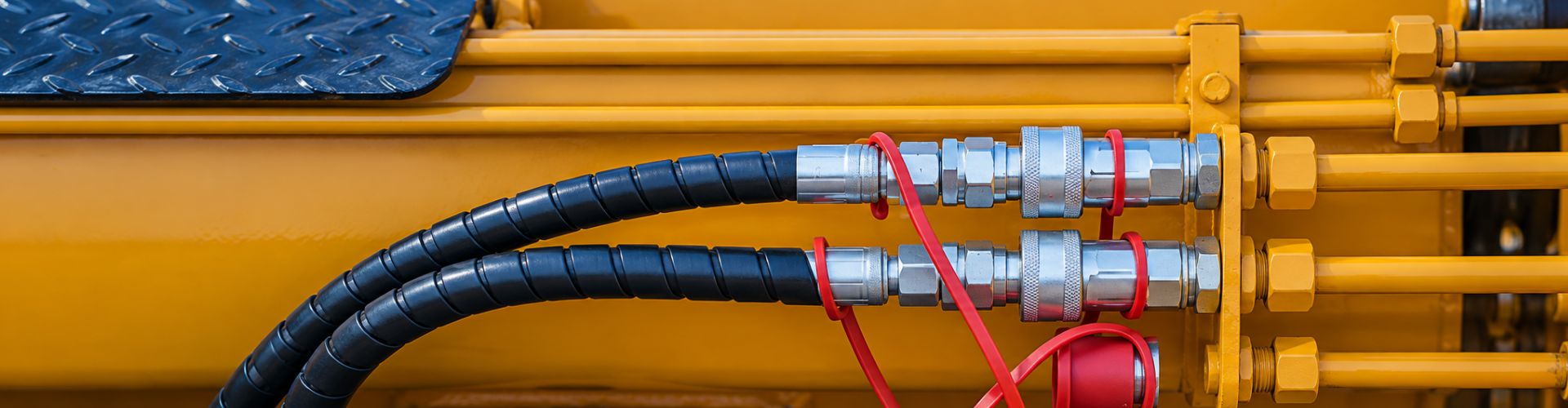
How to Safely Repair Hydraulic Fittings in the Field

How to Safely Repair Hydraulic Fittings in the Field?

Your machine just blew a hydraulic line, miles from the workshop. Now your entire operation is at a standstill, with downtime costing you money with every passing minute.

The best way to handle a field repair is by using field-attachable (reusable) fittings. These allow you to create a new, permanent hose assembly using only basic hand tools, getting your equipment back up and running quickly and safely.

What Safety Steps Are Absolutely Essential Before Starting?

You see hydraulic fluid spraying and your first instinct is to rush in and fix it. This impulse is dangerous and can lead to severe injection injuries, even from systems that appear powered down.

Before touching anything, the absolute first steps are to lock out the machine’s power, completely relieve all stored pressure in the hydraulic system, and put on your required Personal Protective Equipment (PPE). Safety is not optional.

Metric Bite Type Fittings type

Lockout/Tagout (LOTO) is Non-Negotiable

Lockout/Tagout is a formal safety procedure to ensure dangerous equipment is properly shut off and not started up again before the maintenance is complete.

This prevents anyone from accidentally starting the machine while you are working on it.

Releasing Stored Hydraulic Pressure

Turning off the engine is not enough. Hydraulic systems can store energy in accumulators or even within the lines themselves. To release this pressure, you must work the machine’s hydraulic controls (levers, joysticks, etc.) back and forth several times with the engine **off**. You may hear a ‘hiss’ or see the attachments move slightly as the pressure dissipates. Continue until the controls feel loose and unresponsive.

Essential Personal Protective Equipment (PPE)

Hydraulic fluid is a skin and eye irritant. A high-pressure pinhole leak can inject this fluid through your skin, which is a life-threatening medical emergency.

What Are Your Actual Repair Options in the Field?

You’ve made the area safe, but now you’re faced with a broken fitting. What can you actually do with limited tools to create a reliable seal and stop the leak?

Your most effective option is to replace the failed end with a field-attachable, or “reusable,” fitting. For a very temporary fix on certain hose types, a specialized hose repair clamp may be used to get the machine moved.

Reusable Fitting Components Topa

The Best Solution: Field-Attachable Fittings

These fittings are the gold standard for field repairs. They consist of two pieces: an outer socket and an inner nipple. The repair process is mechanical:

This action creates a secure, high-pressure seal. At Topa, we provide these fittings for many common hose types, and they are designed to match the performance of a factory-crimped assembly when installed correctly.

Temporary Fix: Emergency Clamps

In some situations, you might use a bolt-on emergency clamp. These are heavy-duty devices that surround the damaged section of the hose and are tightened with bolts to clamp down on the leak. It is critical to understand that these are temporary, low-pressure solutions meant only to get a machine moved to a safe location for a proper repair. They are not a permanent fix and should not be used in high-pressure or high-vibration applications for any extended period.

What You Must NEVER Do: Welding

Never, ever attempt to weld a hydraulic fitting or tube. The heat from welding can create a catastrophic failure by weakening the metal. More importantly, residual hydraulic fluid inside the line can vaporize into an explosive gas when heated. An attempt to weld a line can turn it into a pipe bomb. There is no situation where welding a pressurized hydraulic component is safe or acceptable.

What Should Be in Your Emergecy Repair Kit?

An equipment failure is stressful enough. The last thing you need is to realize you don’t have the right parts or tools on hand to perform the repair you know how to do.

A well-stocked emergency kit is your best defense against long downtimes. It should contain a curated selection of fittings, hose, and the basic tools needed to perform a field replacement for your specific equipment.

Fieldattachable fittings Install Tools

We actively help our long-term clients build these kits. A fleet manager for a logistics company in the UAE once ordered a huge variety of fittings from us. I worked with him to analyze his fleet’s most common hose sizes and thread types. Based on that, we pre-packaged small “truck kits” with the essentials. This proactive approach has saved his team countless hours. A prepared engineer is an effective engineer.

The Essential Tools

You don’t need a full workshop, just the basics to get the job done. Keep these in a dedicated, easy-to-grab toolbox.

The Critical Components

These are the parts you will be replacing. Your kit should be tailored to your machinery.

The Supporting Items

These small items make the job cleaner, safer, and more successful.

Identify the Problem

Before attempting any repair, the first step is to identify the exact issue with the hydraulic fitting. Misdiagnosis often leads to wasted time, unnecessary part replacements, or even larger failures. Careful inspection ensures you target the true cause of the problem.

Signs of a Failing Hydraulic Fitting

Hydraulic fittings usually give clear warning signs before a total failure. Watch for the following indicators during operation or inspection:

Fail Hydraulic Quick Coupler Maintenance

Quick Field Inspection Checklist

A simple checklist can help technicians quickly assess the problem without dismantling the entire system.

Replace or Reseat the Fitting

When a hydraulic fitting fails, the choice between a quick fix and a full replacement depends on the severity of the damage and the availability of parts in the field. Acting quickly can minimize downtime, but choosing the wrong repair approach may risk safety or system performance.

Temporary vs Permanent Fix

How to Replace a Damaged Fitting

Follow these steps to safely replace a hydraulic fitting in the field:

Field Tip

If no torque wrench is available in the field, tighten the fitting snugly by hand and apply a quarter to half turn with a wrench. Once back in the workshop, recheck torque with calibrated tools.

Test the Repair

Once the fitting has been replaced or reseated, the repair process is not complete until the connection is tested. Skipping this step can result in undetected leaks, leading to repeat failures or safety hazards. A proper test confirms the integrity of the repair before the equipment is returned to service.

System Pressure Test

Verify Reliability

Preventing Future Hydraulic Fitting Failures

Fixing a leak is only part of the job. To reduce downtime and extend system life, it’s critical to adopt preventive measures. Regular inspections and good installation habits can stop small issues from becoming costly failures.

Reusable Hydraulic Fitting hose assembly

Regular Maintenance Checklist

Include these checks in your weekly or monthly schedule:

Long-Term Practices

Beyond routine checks, build habits that strengthen long-term system reliability:

Why Prevention Matters

Consistent maintenance not only prevents leaks but also lowers overall operating costs. By combining inspections, proper training, and standardization, hydraulic systems remain safer, more reliable, and easier to service in the field.

Conclusion

A field repair is about preparation. With a well-stocked kit, a commitment to safety, and knowledge of reusable fittings, you can turn a crisis into a routine, manageable task. At Topa, we supply high-quality Field attachable hydraulic fittings, hoses, and couplings with fast delivery and competitive prices. Send us your inquiry today—our engineering team will provide the best solution for your system needs.


FAQ

What is the quickest way to stop a leaking hydraulic fitting in the field?

The fastest method is to reseat the fitting or replace the O-ring if available. This is only a temporary fix until a proper replacement can be installed.

Can I reuse old O-rings during a field repair?

No. Old O-rings may be cracked, flattened, or chemically damaged. Always use new seals that match the manufacturer’s specifications.

How tight should I make a hydraulic fitting?

Fittings should be tightened to the manufacturer’s torque specifications. If no torque wrench is available, hand-tighten first, then add a quarter to half turn with a wrench.

How do I test a hydraulic fitting after repair?

Slowly re-pressurize the system, inspect the connection for leaks, wipe with a clean cloth, and run the equipment under normal operating conditions.

What tools should I carry for hydraulic field repairs?

A field kit should include O-rings, spare fittings, a thread gauge, torque wrench, sealant, and clean cloths for wiping and inspection.

How can I prevent hydraulic fittings from failing again?

Regularly inspect hoses and fittings, replace worn seals immediately, torque to spec, keep components clean, and train operators to detect early leaks.

How to Select Hydraulic Fittings in 5 Simple Steps

How to Select Hydraulic Fittings in 5 Simple Steps?

Are you an engineer struggling with hydraulic system leaks or failures? Choosing the wrong hydraulic fitting leads to costly downtime, safety hazards, and wasted resources, a problem that frustrates even the most experienced professionals.

You can prevent over 90% of selection errors by following the five-step STAMP method: Size, Temperature, Application, Media, and Pressure. This systematic approach ensures every aspect of your system is considered, leading to a secure and reliable connection.

Step 1: How Do You Define Your System’s Needs with S.T.A.M.P.?

Are you jumping straight to thread types without first understanding your operating conditions? This common mistake is like building a house without checking the foundation; it’s destined to cause problems later.

S.T.A.M.P. is the industry-standard acronym that forces you to define the fundamentals. It stands for Size, Temperature, Application, Media, and Pressure. Answering these five questions first provides the essential data needed to select a compatible and safe fitting.

STAMPED

S for Size

Size is more than just the thread dimension. It primarily refers to the inside diameter (I.D.) of the hose, which determines the flow rate. fittings are sized using “dash numbers” which represent the I.D. in sixteenths of an inch. For example, a -08 fitting is for a hose with an 8/16″ or 1/2″ I.D. Selecting the wrong size can starve the system of fluid or cause excessive velocity, leading to heat and damage. You must match the fitting size to the hose size and the system’s flow requirements.

T for Temperature

You must consider two temperatures: the ambient temperature of the environment outside the hose and the media temperature of the fluid running through it. Extreme cold can make fitting materials brittle, while extreme heat can degrade seals and hose materials. Most standard carbon steel fittings with Buna-N (Nitrile) seals are rated for -40°F to +212°F (-40°C to +100°C). For more extreme temperatures, you may need stainless steel fittings and specialized seals like Viton or Teflon.

A for Application, M for Media, P for Pressure

These three are closely related. Application covers the physical routing, potential for abrasion, and vibration levels. Media refers to the type of fluid being conveyed. Is it a standard petroleum-based hydraulic oil, or a synthetic fluid, water, or chemical that might require special materials like stainless steel? Finally, Pressure is critical. You must know the system’s maximum working pressure, including any potential spikes or surges. The fitting’s pressure rating must always exceed the system’s maximum working pressure.

Step 2: How Do You Accurately Identify the Thread Type?

Have you ever tried to connect a metric fitting to an inch-based port? The threads might seem to catch, but they will never seal correctly, guaranteeing a leak and damaging both components.

You must accurately identify both the type and size of the thread. Use a pair of calipers to measure the thread diameter and a thread pitch gauge to determine the spacing. This is the only way to ensure you are selecting a mating part that will create a perfect seal.

Identifying Hydraulic Fittings Tools

Tapered vs. Straight Threads

This is the first major division. Tapered threads (like NPT and BSPT) are designed to seal by deforming and creating an interference fit along the threads. They always require a sealant like PTFE tape. Straight threads (like JIC, ORFS, and BSPP) do not seal with the threads. Their function is purely mechanical, providing the clamping force to press two separate sealing surfaces together. This could be a metal cone (JIC) or a soft O-ring (ORFS, BSPP). Mixing these two types is a guaranteed failure.

Identifying Common Thread Standards

Once you know if it’s tapered or straight, you need to identify the specific standard.

The Identification Process

Step 3: Which Material is Right For Your Application?

Are you using standard carbon steel fittings in a saltwater environment? Choosing a material that isn’t compatible with your application can lead to rapid corrosion, contamination of the hydraulic fluid, and sudden failure.

The material choice depends directly on your STAMP analysis. For most standard hydraulic systems, zinc-plated carbon steel is the cost-effective workhorse. For corrosive environments or specific media, you must upgrade to stainless steel or brass.

JIC Fitting material

Carbon Steel – The Industry Standard

Carbon steel is the most common material for hydraulic fittings due to its excellent strength and relatively low cost. To protect it from rust, it is almost always coated, typically with an electroplated zinc or a zinc-nickel alloy. This coating provides good resistance to corrosion in most general-purpose applications. It’s the go-to choice for construction, agriculture, and manufacturing machinery where the fittings aren’t exposed to extreme chemicals or saltwater. Its high pressure-holding capability makes it suitable for the vast majority of hydraulic systems.

Stainless Steel – For Corrosion and Purity

When corrosion resistance is the primary concern, stainless steel is the answer. There are two common grades used for fittings:

Brass – For Specific Applications

Brass is an alloy of copper and zinc. It offers very good corrosion resistance and is softer than steel, which allows it to seal well in some low-pressure applications. However, its primary use in hydraulics is where there is a risk of sparking. Because it’s a non-sparking material, it’s often specified for use in explosive environments like underground mines or certain gas facilities. It has a lower pressure rating than steel, so it is typically limited to lower-pressure pneumatic or hydraulic lines.

Step 4: What Fitting Shape Do You Need for Routing?

Are you using multiple straight fittings and adapters to make a 90-degree turn? Every additional connection point you create is another potential leak path and adds unnecessary cost and complexity to your system.

Select a fitting shape that routes the hose directly from port to port with a gentle bend and minimal stress. Use straight fittings for straight runs, and use 45° or 90° elbow fittings to navigate corners and obstacles cleanly.

push locks types

Straight Fittings

Straight fittings are the most common shape. They are used when the hose runs directly away from the port without any immediate turns. They connect a hose to a port, or they can be used to connect two hoses together (as a union). While they are the simplest configuration, you must ensure that there is enough room for the hose to make a natural bend without kinking near the fitting. A kink not only restricts flow but also puts immense stress on the hose’s reinforcement, leading to premature failure.

Angled Fittings (Elbows)

Elbow fittings are essential for efficient plumbing. They are most commonly available in 90° and 45° angles. Using an elbow allows the hose to exit the port at an angle, eliminating the need for a sharp bend. This is critical in tight spaces found on mobile equipment. It reduces the total length of hose required and, most importantly, prevents stress and potential abrasion points that occur when a hose is forced into a tight radius. Always choose an elbow over a straight fitting if the hose needs to make an immediate turn.

Branch Fittings (Tees and Crosses)

Tees and crosses are used to split a single hydraulic line into two or more lines or to combine multiple lines into one. A tee fitting has one inlet and two outlets (or vice-versa), while a cross has one inlet and three outlets. These are vital for creating more complex circuits where you need to send fluid to multiple actuators from a single pump, or where you need to install gauges and sensors into a line. Using a single tee is far more reliable and professional than trying to stack multiple adapters to achieve the same result.

Step 5: How Do You Verify the Supplier and Standards?

You’ve found a fitting that looks right online for a very low price. But how do you know if it meets international quality standards, or if the supplier will still be there to support you tomorrow?

Always choose a supplier who can prove their products conform to international standards like SAE, ISO, and DIN. Furthermore, evaluate the supplier on their service, responsiveness, and technical support, not just the price. A reliable partner is worth more than a cheap part.

SAE EN ISO

Why International Standards (SAE, ISO, DIN) Matter

International standards are a guarantee of interchangeability and performance. When a fitting is made to an SAE J514 (JIC) or ISO 8434-2 standard, you can be confident that it will properly connect with any other fitting made to that same standard, anywhere in the world. These standards dictate everything from thread dimensions and tolerances to burst pressure requirements and material composition. A fitting without a clear standard is a complete gamble. Always demand that your supplier specify the standards their products meet.

Evaluating a Supplier’s True Value

A low price is tempting, but it can hide many costs. A truly valuable supplier offers more.

The Hidden Costs of a Bad Supplier

Choosing a poor supplier can be disastrous. You may receive parts that fail prematurely, causing expensive equipment damage and dangerous situations. You could face production delays because of late shipments or incorrect parts. If a part fails in your customer’s machine, it damages your own reputation. The money you saved on a cheap fitting is quickly lost to rework, downtime, and lost business. Investing in a quality part from a reputable supplier is an investment in peace of mind.

Conclusion

Selecting the right hydraulic fitting is easy with the 5-step method: use S.T.A.M.P., identify threads, choose your material and shape, and verify your supplier. This secures a leak-free, reliable system.

At Topa, we provide reliable hydraulic fittings, hoses, and adapters that meet SAE, ISO, and DIN standards. With fast response, wide product range, and strict quality control, we ensure leak-free and durable connections for your systems. Contact us today to request a quote!


FAQ

What is the STAMP method in hydraulic fitting selection?

STAMP (Size, Temperature, Application, Media, Pressure) is a systematic approach that ensures fittings are chosen based on actual system conditions for safe and reliable performance.

Why does thread identification matter in hydraulic fittings?

Correctly identifying thread type and size prevents mismatches like BSP vs NPT, which can cause leaks, damage components, and compromise system safety.

Which material is best for hydraulic fittings?

Carbon steel suits general use, stainless steel is ideal for corrosion environments like marine or chemical, and brass is used in low-pressure or spark-free conditions.

How do I select the correct fitting shape?

Choose straight fittings for direct runs, elbows for bends, and tees or crosses for branching lines; reducing adapters lowers leak risks and simplifies routing.

Why should I only buy fittings that meet ISO, SAE, or DIN standards?

Certified standards guarantee proper dimensions, sealing, and pressure ratings, ensuring fittings are interchangeable, durable, and globally compatible.

What are the risks of choosing a low-cost, uncertified supplier?

Cheap suppliers may deliver fittings with poor tolerance or weak materials, leading to leaks, downtime, safety hazards, and higher long-term costs.

How to Choose the Right Hydraulic Fitting Seal

How to Choose the Right Hydraulic Fitting Seal?

Struggling with persistent leaks at your hydraulic ports? Choosing the wrong seal type leads to incorrect orders, frustrating trial-and-error, and a system that is simply not reliable.

The right fitting seal depends on the port’s design. Use an ED seal for flat-faced ports, an O-ring for ports with a chamfer or groove, and only use tapered threads like NPT or BSPT when specified, as they are prone to leaks.

When is an ED Seal the Right Choice for Your Port?

Have you ordered a hydraulic fitting that just won’t seal, no matter how tight you make it? You may be trying to use the wrong seal type for your port’s flat surface, leading to leaks and damaged components.

An ED (Elastomer Dowty) seal is the correct choice for ports with a perfectly flat machined surface and parallel threads, such as Metric (M) or BSPP (G). It uses a bonded washer to create an extremely reliable, high-pressure static face seal.

ED Seal

The ED seal, often called a bonded seal or Dowty washer, is a modern and highly effective sealing solution. It consists of a metal outer ring with a vulcanized rubber trapezoid ring bonded to the inside. When the fitting is tightened, the rubber part is compressed against the flat face of the port, creating a contained, high-pressure seal.

Key Characteristics and Application

The design is simple but precise. The metal ring prevents over-compression and extrusion of the rubber seal, while the rubber provides the flexible sealing element.

Why it Replaced Older Methods

The ED seal is a direct technological improvement over the older “combination washer,” which was a simple metal washer with a separate loose O-ring. The bonded design of the ED seal prevents the elastomer from being lost, incorrectly installed, or extruded under pressure, making it a much more robust and foolproof solution for modern hydraulic machinery.

Why Are O-Ring Seals So Common and Reliable?

Confused by ports that have a strange cone shape or groove in them? Trying to use a flat washer or ED seal on these ports will guarantee a leak and cause endless frustration.

O-ring seals are used for ports designed with a specific groove or chamfer to house the O-ring. This design allows the O-ring to be compressed in a controlled way, creating a highly effective and reusable seal that is common on SAE, JIC, and ORFS fittings.

oring vs without o ring

The O-ring is one of the most versatile and widely used seals in all of engineering, and hydraulics is no exception. It is a simple torus, or donut-shaped ring, made of an elastomeric material. Its sealing principle relies on mechanical deformation. When the fitting is tightened, the O-ring is squeezed into a specially designed cavity, filling every microscopic gap and creating a formidable barrier against high-pressure fluid. The popularity of this method, especially in North American equipment (SAE standard), is due to its incredible reliability and reusability. A single glance at the port can tell you if an O-ring is needed.

Identifying Ports for O-Ring Seals

Unlike the flat face needed for an ED seal, O-ring ports have specific geometry.

Advantages Over Other Methods

The O-ring offers several distinct advantages that make it a go-to choice for many manufacturers.

What Are the Risks of Using Tapered Thread Seals like NPT and BSPT?

Are you still using common pipe threads for high-pressure hydraulic lines? This old technology is a frequent source of leaks, thread damage, and system contamination, making it a risky choice for modern machinery.

Tapered thread seals, like NPT and BSPT, create a seal by wedging the threads together. This “dry seal” is prone to leakage under vibration, can damage ports if over-tightened, and requires sealant that can contaminate the system.

Topa 4N NPT Hydraulic Fittings

Tapered threads are one of the oldest sealing methods, carried over from general plumbing and pipe work. Unlike modern fittings where the threads provide clamping force and a separate element (like an O-ring or ED seal) does the sealing, tapered threads attempt to do both jobs at once. As the hydraulic fitting is tightened, the male and female cones wedge together, creating a seal through metal deformation. The problem is that this is an imperfect, brute-force method that is not well-suited for the high pressures and dynamic loads of modern hydraulic systems. We manufacture them because they are still used in some applications, but we always advise caution.

Key Differences and Identification

It is critical to correctly identify and never mix the two main types of tapered threads.

Mixing NPT and BSPT fittings is absolutely forbidden. The different thread angles and pitches mean they will never form a proper seal and will leak immediately, while also damaging the threads on both the male and female components.

Why Tapered Threads Are Problematic in Hydraulics

While simple, this sealing method comes with significant drawbacks.

How Do ED Seals and O-Ring Seals Differ for Port Connections?

Not sure whether a parallel thread port requires an ED seal or an O-ring? Choosing incorrectly will prevent a proper seal and can damage the fitting or the port during tightening.

The key difference is the port’s face geometry. An ED seal requires a completely flat surface to seal against. An O-ring seal requires a corresponding feature, like a chamfer or groove, to be compressed into. Both use parallel threads for clamping force.

This is one of the most common points of confusion for technicians and engineers in the field. Both ED seals and O-ring seals are used with parallel threads (like BSPP and Metric), and both offer excellent, high-pressure performance. The choice between them is not about which is “better” in general, but which one is specifically designed for the machine’s port. The machine’s manufacturer has already made the decision by machining the port in a specific way. Your job is to correctly identify that design feature and use the corresponding fitting and seal.

A Simple Visual Identification Guide

The decision comes down to a quick visual inspection of the port you are connecting to.

Sealing Action

Are Older Sealing Methods Like Combination Seals Still Relevant?

Encountered an old fitting that uses a metal washer and a separate O-ring? While this technology works, it has been almost entirely replaced by more reliable and user-friendly sealing solutions.

Older methods like the “combination seal” (plain washer + O-ring) and the “composite bonded washer” are early-generation technologies. They are now considered obsolete and have been superseded by the superior, one-piece ED (Dowty) seal for most modern applications.

Washer + O-Ring

In the world of hydraulics, technology is always advancing to improve reliability and safety. The evolution of port sealing methods is a perfect example of this. While you might still encounter these older seals on legacy equipment or in certain niche applications, they are no longer the standard for new designs. As a supplier that supports both new and old machinery, we understand these legacy parts, but we also recognize why they were replaced. The modern ED seal solved the inherent problems of these earlier multi-part or weaker designs.

The Combination Seal (Washer + O-Ring)

The Composite Bonded Washer (Old National Standard)

Conclusion

Choosing the correct hydraulic seal is not complex; it is a matter of careful observation. Matching the seal type—ED, O-ring, or tapered—to the port’s design is essential for a leak-free, reliable system.

At Topa, we provide a full range of high-quality hydraulic fittings and seals to meet any standard. Our team offers expert guidance and fast quotations to ensure you get the right component for the job, every single time.


FAQ

How do I choose the right hydraulic fitting seal?

Check the port design. Use an ED seal for flat-faced ports, an O-ring for ports with a chamfer or groove, and tapered threads (NPT/BSPT) only when specified.

When should I use an ED seal?

Use an ED seal when your port has a perfectly flat surface and parallel threads, such as BSPP (G) or Metric (M) threads. It creates a strong, static face seal for high pressure.

What ports require O-ring seals?

O-ring seals are ideal for ports with a chamfer, cone, or groove, like SAE-ORB, ORFS, and Metric ports. The O-ring compresses to fill the cavity and create a leak-free seal.

Why are tapered threads like NPT or BSPT risky?

Tapered threads seal by metal wedging, which can cause leaks, port cracking, or thread damage if overtightened. They also need sealant, which may contaminate the hydraulic system.

What’s the difference between an ED seal and an O-ring?

An ED seal works on a flat port face and acts like a bonded washer. An O-ring seals inside a chamfer or groove. Both use parallel threads for clamping force but different sealing actions.

Are older sealing methods still used?

Older designs like combination seals (washer + O-ring) are mostly obsolete. They’ve been replaced by modern ED seals, which offer better pressure resistance and installation reliability.

U.S.100% Tariffs What Hydraulic Distributors Need Now

U.S.100% Tariffs: What Hydraulic Distributors Need Now

In October 2025, the U.S. government imposed 100% tariffs on Chinese imports — a move that directly impacts the global hydraulic fittings and hose industry.

The Tariff Announcement and Its Immediate Implications

U.S.100% Tariffs

The 100% Tariff Explained

According to **Reuters (2025.10.10)**, the U.S. announced 100% tariffs on Chinese imports to “protect U.S. industry.” This measure marks a significant escalation from prior trade policies, targeting a broad range of industrial goods, including hydraulic fittings and hoses used in manufacturing, construction, and agriculture.

The Scale of Impact

The Financial Times (2025.10.10) reported that more than $150 billion in Chinese goods are affected — the largest escalation since 2018. Hydraulic components, which fall under steel and brass mechanical parts, are within this scope. Immediate consequences include cost surges, disrupted deliveries, and sourcing uncertainty for U.S. buyers.

Inflation and Global Supply Chain Disruption

High Pressure Hose Assembly Failure

Rising Import Costs and Inflation

Bloomberg Economics (2025.10.11) estimates the tariffs will push U.S. import prices up by **7%**, potentially lowering global GDP by 0.3% in 2026. In the hydraulic sector, that price spike translates directly into higher manufacturing and maintenance costs, as most fittings and hoses depend on Chinese machining and plating capabilities.

Supply Chain Fragmentation

Tariffs disrupt established logistics networks. U.S. importers are shifting sourcing toward Vietnam, India, and Mexico, but these countries lack China’s precision standards in machining, zinc-nickel plating, and assembly, creating inconsistencies in thread accuracy and hose crimping performance.

Market Impact Overview

Operational Stress Points

Factories dependent on Chinese raw materials — carbon steel bars, brass billets, and coating chemicals — face shortages. Production delays in fittings and hoses ripple through construction, mining, and machinery industries globally.

Global Reactions and Industry Adjustments

China’s Response and WTO Implications

AP News (2025.10.11) quoted China’s Ministry of Commerce calling the move “a serious violation of WTO principles.” Retaliation has begun, including new port fees on U.S. ships. This adds non-tariff pressure to logistics, potentially increasing freight costs for hose assemblies by up to 20%.

Policy Confirmation and Legal Framework

The USTR (2025.10.11) published the new duty structure under Section 301 Tariff Actions in the *Federal Register*, cementing it as a long-term policy. Legal challenges via WTO may take years, meaning manufacturers must adapt rather than wait for relief.

The Reshaping of the Hydraulic Supply Chain

Navigating New Tariffs in the world

Shifts in Sourcing and Manufacturing

The 100% tariff has triggered a fundamental restructuring of how hydraulic fittings and hoses are sourced, produced, and distributed worldwide. For more than two decades, China has been the backbone of this industry, offering unmatched precision in CNC machining, zinc-nickel plating, automated hose crimping, and large-scale production efficiency. Now, that dominance is being challenged as U.S. buyers and global distributors urgently look for alternatives to avoid the new tariffs.

Southeast Asia—particularly Vietnam, Thailand, and Malaysia—has become the first destination for this redirected demand. These countries are rapidly scaling their manufacturing capacity through joint ventures, technology transfers, and government incentives. However, while their labor costs are competitive, their production ecosystems are still maturing. Critical challenges include inconsistent raw material quality, limited access to high-precision forging equipment, and less-developed testing infrastructure for pressure and salt-spray resistance.

Mexico, driven by its proximity to the U.S., is another strategic hub. Under the USMCA framework, hydraulic components produced or assembled in Mexico may qualify for reduced tariffs, offering U.S. buyers a partial escape route. However, limited domestic steel and brass supply, coupled with higher operating costs, still restrict Mexico’s scalability in this sector.

In contrast, Chinese manufacturers are not standing still. Many are adopting a “China +1” strategy—maintaining their domestic production for Asian and European markets while setting up satellite plants abroad for U.S.-bound orders. This allows them to preserve quality control, maintain brand trust, and reduce dependence on any single trade corridor.

Future Market Structure

How Manufacturers Like Us Will Respond

Domestic Supply Chain Optimization

We are consolidating our partnerships with local raw material suppliers for carbon steel, stainless steel, and brass — ensuring that all bar stock and forging billets meet mechanical and chemical standards before machining begins. By working directly with certified mills and plating specialists inside China, we shorten delivery cycles, improve traceability, and reduce exposure to fluctuating import material costs.

Additionally, we’ve implemented a **tiered supplier evaluation system**, ranking partners based on their delivery accuracy, plating consistency, and dimensional tolerance stability. This data-driven assessment helps us identify weaknesses, provide technical feedback, and co-develop improvements in real time.

Our logistics chain is also undergoing digital optimization. Using ERP integration and smart warehousing, each batch of fittings and hoses can be tracked from forging to final shipment. This ensures zero mix-ups, zero missing items, and complete transparency for customers — even across multiple production lines.

profile projector test Topa

Full Automation for Stability and Precision

The second pillar of our strategy is full automation. In a high-tariff environment, efficiency becomes the most powerful form of cost control. That’s why we are replacing manual operations with **CNC-integrated production, robotic assembly, and automated hose crimping systems**.

Our CNC centers are equipped with real-time dimensional feedback, capable of machining to tolerances below ±0.01 mm. Automated robotic arms handle repetitive assembly tasks such as nut installation, thread cleaning, and O-ring insertion — improving both accuracy and safety.

In the hose assembly section, AI-based crimping machines now adjust pressure and die settings automatically based on hose diameter and material hardness.

Building a Smarter, Stronger Domestic Manufacturing Network

By combining an optimized local supply chain with advanced automation, we are reinforcing our position as a reliable, self-sufficient hydraulic fittings manufacturer.

This strategy not only shields us from external policy risks like tariffs or shipping disruptions but also enhances our long-term competitiveness.

Our focus remains clear — **produce faster, test deeper, and deliver better**.

Quality and Traceability Focus

High tariffs and shifting supply chains have made one truth undeniable: trust is the new currency of global trade. In an environment where component origins may span multiple countries, we are reinforcing our quality assurance system with greater transparency and verifiable data.

We have implemented **ISO 9001 and ISO 14001-compliant traceability protocols**, covering every stage from raw material certification to final inspection. Each hydraulic fitting and hose assembly carries a unique traceability code linking it to its production batch, plating test results, and inspection records.

Our 100% inspection policy ensures that no fitting leaves the factory without passing dimensional, pressure, and plating integrity tests. For corrosion resistance, we maintain continuous **salt-spray testing cycles exceeding 96 hours**, simulating years of real-world exposure to harsh environments.

Ultimately, our response goes beyond survival; it’s about strengthening the foundation for the next era of hydraulic manufacturing. By combining technological precision, flexible supply networks, and uncompromising quality control, we ensure that our fittings and hoses remain reliable, compliant, and competitively positioned — no matter how trade policies evolve.

Long-Term Trends in the Hydraulic Industry

Sustainability and Material Innovation

The 100% tariff has forced both manufacturers and end-users to rethink the long-term sustainability of the hydraulic industry. Rising costs and trade barriers are pushing the market to adopt **longer-lasting materials, cleaner production methods, and smarter product design**.

In fittings, stainless steel is emerging as the new standard. Its superior corrosion resistance, strength, and temperature tolerance make it ideal for industries like marine engineering, construction, and oil & gas — sectors where component failure is unacceptable. The 316 stainless series is replacing lower-cost carbon steel, not just for durability but also for lifecycle economy: one stainless steel fitting can outlast three carbon steel fittings in harsh conditions.

Meanwhile, zinc-nickel coatings are becoming the preferred finish for carbon steel fittings. Offering over 720 hours of salt-spray resistance, this coating reduces maintenance frequency and environmental contamination from rust. It also eliminates the use of hexavalent chromium, aligning with RoHS and REACH environmental regulations.

Hydraulic hose manufacturing is following the same trend. The next generation of hoses will feature bio-based or recyclable inner tubes that reduce carbon footprint without sacrificing flexibility or pressure endurance. Advanced polymers like TPU and EPDM blends are being engineered to withstand hydraulic fluids while resisting UV damage and temperature extremes.

The future of hydraulic manufacturing will not be defined by who offers the lowest price, but by who can deliver durability, compliance, and environmental responsibility in a single product line.

Burst Pressure test

Automation and Localization

While sustainability drives material innovation, automation and localization define the next competitive frontier. Western buyers — particularly in the EU and North America — increasingly demand traceable, precision-engineered components from suppliers capable of providing consistent quality documentation.

Automation is the foundation of this reliability. In leading Chinese factories, production is shifting from semi-manual processes to **fully robotic CNC lines, automated deburring, and AI-assisted quality inspection**. Each fitting is measured, tested, and serialized automatically, creating a digital production record that can be accessed by international clients.

These digitalized systems also enable **predictive maintenance and adaptive machining**, reducing downtime and ensuring every thread and sealing surface meets ISO 8434 and SAE J514 standards. By combining robotics and data analytics, manufacturers achieve both **scalability and consistency**, even across multiple production shifts.

In the long term, the hydraulic supply chain will evolve into a **globally distributed yet digitally unified system**. Core components may still be produced in China — where technical expertise and machining depth remain unmatched — but finishing, customization, and logistics will be decentralized.

For the hydraulic fittings and hose industry, this model blends the best of both worlds: the efficiency of centralized manufacturing with the agility of regional responsiveness. It’s a transformation that promises not only survival under trade pressure but also a stronger, more sustainable foundation for the decades ahead.

Navigating the Next Five Years

Forecast Summary

If the 100% tariff persists for 3–5 years, hydraulic fitting prices in the U.S. may remain **25–40% above pre-tariff levels**, while demand shifts toward premium and locally assembled products. Export-oriented manufacturers must align with regional partners, certification systems, and multi-origin strategies.

Competitive Outlook

In the next five years, the winners will not be those who compete solely on price, but those who combine engineering precision, transparent quality control, and sustainable practices. The hydraulic sector is evolving toward a future where reliability and trust outweigh short-term cost — and those prepared to adapt today will lead tomorrow’s market.

If you are looking for a dependable long-term supplier of hydraulic fittings, hoses, and custom assemblies, contact us today.


FAQ

Why does the 100% U.S. tariff have such a strong effect on hydraulic fittings and hoses?

Because over 60% of global hydraulic fittings and hose assemblies are sourced from China. The tariff directly increases landed costs, disrupts established supply chains, and forces U.S. distributors to find alternative suppliers — often at the expense of quality consistency and delivery speed.

How are Chinese manufacturers responding to the tariff challenges?

Instead of moving production overseas, many are optimizing their domestic supply chains and investing heavily in **full automation**. By upgrading CNC machining, robotic assembly, and digital quality tracking, they are maintaining international standards while avoiding reliance on foreign subcontractors.

What short-term market disruptions are expected after the tariff?

In the first 12–18 months, the industry will face price hikes of **15–30%**, extended lead times. Some smaller distributors may pause imports or shift to partial local assembly to manage cash flow.

How will this situation change the hydraulic industry over the next 3–5 years?

The tariff will accelerate the shift toward **high-end stainless steel fittings, zinc-nickel coatings, and sustainable hoses**. Automation and regional assembly hubs will become standard. The industry will evolve from cost-driven manufacturing to a model built on **traceability, durability, and compliance**.

What are the main advantages of working with automated Chinese manufacturers like Topa?

Automation ensures precise machining tolerances (±0.01 mm), consistent plating, and faster throughput. Combined with domestic supplier control and full traceability, manufacturers like Topa can deliver **stable quality, shorter delivery cycles, and tariff-resilient pricing**.

How can international buyers reduce their risks and maintain stable supply?

By forming long-term partnerships with manufacturers who have **integrated domestic production, verified ISO quality systems, and digital traceability**. Customers who collaborate early on inventory planning and customized packaging solutions can minimize both tariff and logistics risks.

Reference

How to Match 1B, 2B, and 3B Threads for Reliability

How to Match 1B, 2B, and 3B Threads for Reliability?

Are you tired of dealing with persistent hydraulic leaks, but can’t quite pinpoint why your threaded connections loosen or weep fluid? Often, the solution lies in a hidden detail: the thread class.

Understanding thread classes like 1B, 2B, and 3B is crucial for leak prevention in hydraulic systems. Choosing the correct thread class ensures a precise fit, uniform sealing, and long-term reliability in your connections, directly combating the frustrating problem of hydraulic fluid leakage.

What Do 1B, 2B, and 3B Thread Designations Really Mean?

Have you ever seen “1B” or “2B” stamped near a threaded hole and wondered what it signified beyond just a size?

In American National Standard (UN/UNR) threads, designations like 1B, 2B, and 3B define the internal thread’s (hole or nut) tolerance class, with “B” indicating internal threads and the number (1, 2, or 3) indicating the precision or looseness of the fit. Understanding these basic elements is the first step toward creating secure, leak-resistant hydraulic connections.

2B 2A Thread gauge

At its core, a thread designation combines a number and a letter, each carrying a specific meaning crucial for engineering and assembly. These designations are part of the Unified Thread Standard (UTS), which is widely used in the United States and Canada. This system ensures interchangeability and compatibility between different manufactured components.

Unpacking the Code

The Number (1, 2, or 3):

Represents the Tolerance Class (also known as Precision Grade).

This number indicates the permissible range of variation in the thread’s form, pitch, major diameter, and minor diameter. It dictates how tightly or loosely the threads will fit together when assembled with an external thread (like a bolt or a fitting’s male end).

A higher number (e.g., 3) signifies a tighter tolerance and higher precision. This means the manufacturing process must be more controlled, resulting in a thread that deviates very little from its theoretical perfect form. This tighter control creates a connection with minimal clearance.

A lower number (e.g., 1) signifies a looser tolerance and lower precision. This allows for greater variation in manufacturing, resulting in a thread with more clearance. This provides a more forgiving fit, especially in conditions where minor imperfections might exist.

The Letter (B):

Designates Internal Threads.

The capital letter “B” specifically refers to internal threads, which are those machined into a hole (like a hydraulic port on a valve body) or found inside a nut. When you see “B,” you know you are looking at a female thread.

Conversely, for external threads (like those on a bolt, a male hydraulic fitting, or a threaded rod), the letter “A” is used (e.g., 1A, 2A, 3A). These terms “A” and “B” always denote whether the thread is male or female, regardless of the precision level.

How Does Each Thread Class Impact Seal Integrity and Leak Prevention?

Are you struggling with leaks because components feel too loose or too tight? Understanding the inherent fit difference between 1B, 2B, and 3B threads is key to achieving leak-free hydraulic connections.

The core difference among 1B, 2B, and 3B lies in their manufacturing tolerances: 1B offers the loosest fit for easy assembly in non-critical scenarios, 2B provides a balanced, general-purpose fit ideal for most hydraulic applications to prevent leaks, and 3B delivers the tightest, most precise fit for critical, high-performance systems requiring maximum leak prevention and stability.

Here is a breakdown of the core differences and their implications for leak integrity:

Matching Internal and External Threads for a Leak-Proof Connection

Do your hydraulic fittings sometimes feel too loose, too tight, or even jam when you try to assemble them? Improperly matched thread classes are likely the culprit, leading directly to leaks and connection failure.

For a leak-proof and durable hydraulic connection, the internal thread (B class) must be correctly paired with the external thread (A class). This ensures the optimal fit, balancing ease of assembly with the required sealing integrity, and preventing issues like stripping, galling, or eventual leakage that arise from mismatches.

1A 2B 3B UNF Threads

Understanding the “A” Classes (External Threads):

Just as “B” denotes internal threads, “A” denotes external threads (like those on bolts, machine screws, or the male ends of hydraulic fittings). The numbers (1, 2, 3) signify the same tolerance levels as with “B” classes:

Critical Matching Principles for Leak Prevention

The goal is to achieve an appropriate “fit” (loose, free, or tight) that supports the sealing mechanism (whether it’s thread engagement itself, a face seal, or a thread sealant) and dynamic conditions.

1B Internal Thread → Pair with 1A or 2A External Thread

This combination is designed for very easy assembly, even with threads that are slightly damaged, dirty, or have a thick coating (like heavy paint or hot-dip galvanizing).

Leak Implication: The significant clearance in this fit means it offers very limited inherent leak prevention. For hydraulic systems, this combination would almost certainly require additional external sealing methods (like an O-ring on a face, or copious amounts of thread sealant) to prevent weeping.

2B Internal Thread → Pair with 2A External Thread

2B Internal Thread → Pair with 2A External Thread (Most Common, Free Fit):

This is the standard, most versatile, and widely recommended combination for the vast majority of commercial and industrial applications, including hydraulic fittings.

Leak Implication: The “free fit” provides enough clearance for smooth, easy assembly without excessive play. This allows for good thread engagement, ensuring that thread sealants can fill the spaces effectively. It offers a reliable and consistent seal when tightened properly.

3B Internal Thread → Must Pair with 3A External Thread

This combination offers the smallest clearances and results in the tightest possible fit. It is designed for applications where precise alignment, maximum thread engagement, and superior resistance to loosening under extreme conditions are paramount.

Leak Implication: This “tight fit” excels at preventing leaks in critical, high-pressure, or high-vibration hydraulic systems. The minimal clearance offers very effective metal-to-metal contact, enhancing anti-vibration properties and forming an exceptionally robust connection that significantly reduces the potential for fluid escape through the threads.

Critical Warning: Avoid Mismatches!

High-Precision Internal (3B) with Low-Precision External (1A or 2A): This is a critical mismatch. A 3B internal thread has very little allowance. If you try to assemble it with a looser 1A or 2A external thread (which has more manufacturing variation), the larger physical dimensions allowed by the 1A/2A tolerance might interfere with the tight 3B internal thread. This often results in:

By diligently selecting matching A and B thread classes, particularly using the widespread 2A/2B combination for general purpose, or the precise 3A/3B for critical applications, you can effectively manage thread clearances to prevent the common issues that lead to hydraulic leaks.

Why 2B Threads Are the Go-To Standard for Most Hydraulic Fittings

Are you debating which thread class to specify for your everyday hydraulic fittings, worrying about potential leaks or assembly issues? For 95% of applications, the 2B thread class is the undisputed best choice.

The 2B thread class is the ultimate standard for most hydraulic fittings because it delivers an optimal balance of precise fit, ease of assembly, and consistent sealing performance.

2B Thread gauge

The Perfect Compromise for Leak Prevention

The unique characteristics of 2B contribute directly to preventing leaks in everyday scenarios.

When to Rely on 2B

When Do 3B Threads Prevent Leaks in Critical Applications?

The 3B thread class is crucial for preventing leaks in highly critical hydraulic applications where extreme precision and maximum connection stability are absolute necessities. Its minimal clearance provides superior resistance to loosening from intense vibration or pressure fluctuations, making it indispensable for aerospace, military, and precision instrument systems where zero leakage is non-negotiable.

3B Thread gauge

While the 2B thread class serves as an excellent general-purpose solution for leak prevention, there are specific, high-stakes scenarios where its inherent clearances might be insufficient. In these environments, even a minor leak could lead to catastrophic failure, compromise safety, or disrupt highly sensitive operations. For such critical applications, the 3B thread class emerges as the ultimate answer. Its meticulously tight tolerance, when properly matched with a 3A external thread, delivers a level of connection integrity and leak resistance that justifies its higher manufacturing cost and more demanding assembly requirements.

Where 3B Threads Make the Difference for Leak Prevention

The enhanced precision of 3B directly translates to superior leak resistance in challenging conditions.

How Other Standards Tackle Leak Prevention Through Tolerances

Are you only familiar with 1B, 2B, 3B, but work with hydraulic systems from around the world? Different thread standards use their own methods to define precision, all aiming for leak-free connections.

While 1B, 2B, and 3B are unique to American National Unified (UN/UNR) threads, other global standards like Metric and British threads use similar principles of tolerance and fit to prevent leaks. Metric threads use alphanumeric “tolerance grades” (e.g., 6H for internal threads), while British threads have their own legacy classification systems, all designed to ensure precise mating for reliable fluid sealing.

Metric gauge

Metric Threads (ISO Metric Screw Threads)

Metric threads, defined by ISO (International Organization for Standardization), are the most widely used thread standard globally. They employ a more detailed system of “tolerance grades” and “tolerance positions” to define clarity.

British Whitworth Threads (BS 84 / BS 93)

Historically, British Whitworth threads (W or BSW) were used extensively, though they are less common in new designs today, especially in hydraulics, as metric and UN threads dominate. Whitworth threads have a 55-degree flank angle, distinct from the 60-degree angle of UN and Metric threads. They also had their own “fit” classifications.

Pipe Threads (NPT/NPTF, BSPT, BSPP)

Pipe threads are a separate category of threads specifically designed for fluid conveyance and sealing, often differing significantly from parallel (straight) mechanical threads.

Summary Comparison Table

Conclusion

Regardless of the thread standard (UN, Metric, or Pipe threads), diligently matching internal and external threads and adhering to proper installation practices are paramount for achieving and maintaining leak-free hydraulic systems.

Are you ready to permanently solve your hydraulic leak problems by making informed choices about your threaded connections? Contact the Topa team today to discuss your requirements and discover how our precision-engineered hydraulic fittings can enhance the leak integrity and performance of your hydraulic systems.


FAQ

What do 1B, 2B, and 3B thread classes mean?

These thread classes define the tolerance or precision level of internal threads under the Unified Thread Standard. 1B is the loosest fit, 2B is standard for general use, and 3B provides the tightest, most precise fit for critical applications.

Why are thread classes important in hydraulic systems?

Thread classes determine how tightly two threaded components fit together. The correct class ensures proper sealing, prevents leaks, and maintains connection stability under pressure and vibration.

Which thread class is best for hydraulic fittings?

The 2B thread class is the most widely used because it offers a perfect balance between assembly ease, manufacturing cost, and reliable sealing, making it ideal for most hydraulic applications.

What happens if thread classes are mismatched?

Mismatching classes—such as using a 3B internal thread with a 1A or 2A external thread—can cause galling, cross-threading, or incomplete engagement, leading to leaks, connection failure, or permanent thread damage.

When should 3B threads be used?

3B threads are recommended for high-precision or high-pressure environments like aerospace, military, and advanced hydraulic systems where even minor leakage or vibration loosening cannot be tolerated.

How do other thread standards compare to 1B, 2B, and 3B?

Metric and British threads use similar tolerance systems, such as 6H for metric internal threads, to achieve the same goal—ensuring precise fits, secure connections, and leak-free performance in hydraulic systems.

How to Choose and Use Reusable Hydraulic Fittings

How to Choose and Use Reusable Hydraulic Fittings?

Struggling with hydraulic leaks and costly downtime? Field repairs can be a headache when you don’t have the right parts, causing frustrating delays and lost profits on the job.

The key to successfully using reusable hydraulic fittings is ensuring proper identification, assembly, and inspection. These fittings, which don’t require special crimping machines, can be assembled and disassembled with basic hand tools, making them ideal for quick, reliable field repairs if done correctly.

What Exactly Makes a Fitting Reusable?

Confused about what “reusable” really means for hydraulic fittings? Misunderstanding this term can lead to improper use, unexpected system failures, and wasted components, costing you time and money.

A hydraulic fitting is considered “reusable” because its two-piece design—a socket and a nipple—allows it to be attached to a hose without a crimper. This means you can disassemble it from an old hose and re-install it on a new one using only hand tools.

reusable Hydraulic hose Fittings drawing

The brilliance of the reusable fitting lies in its mechanical design. Unlike permanent crimp fittings that are compressed onto a hose, reusable fittings work on a thread and seal principle. This design is what makes them “field attachable,” a term we often use in the industry.

The Core Components: Socket and Nipple

The fitting consists of two main parts. The socket is the outer shell with an internal thread. The nipple is the inner part that goes inside the hose tube. When you assemble it, the hose is essentially clamped securely between these two components. This simple, robust design is what gives it strength.

Why No Special Tools Are Needed

The assembly relies on mechanical threading. You screw the socket onto the outside of the hose, and then you screw the nipple into the socket. The threads do all the work of creating a tight, high-pressure seal. This is why you only need standard wrenches for the job, making it perfect for on-the-spot repairs.

How Do You Properly Match a Reusable Fitting to a Hose?

Choosing the wrong hose and fitting combination? This common mistake guarantees a weak connection, leading to dangerous leaks, hose blow-offs, and damage to your expensive hydraulic equipment.

To correctly match a reusable fitting, you must ensure three things: the hose type is compatible (e.g., 100R2AT), the fitting series matches the hose, and the inside diameters of both the hose and fitting are identical. Check manufacturer specifications for confirmation.

install Reusable hose fitting

I cannot stress this enough: compatibility is not something you can guess. In my experience dealing with customers from the Philippines to the USA, mismatching is the root cause of over half of all fitting failures. A fitting designed for a one-wire braid hose (like 100R1) will not seal properly on a two-wire braid hose (100R2), because the outer diameters and construction are different. The socket is designed to grip a specific hose thickness and cover type. Using the wrong one means you’re creating a failure point from the very beginning.

Understanding Hose Designations

Hydraulic hoses have codes like “SAE 100R1AT” or “SAE 100R2AT.” These aren’t just random numbers. They specify the hose’s construction, pressure rating, and number of wire reinforcement layers. Reusable fittings are engineered to work with these specific constructions.

The Importance of Dash Sizes

Both hoses and fittings use a “dash size” system (e.g., -04, -06, -08) to indicate the inside diameter (I.D.) in sixteenths of an inch. A -08 hose has an I.D. of 8/16″ or 1/2″. You must match the dash sizes perfectly. A -06 fitting will not work on a -08 hose.

Here’s a quick reference table we provide to our clients.

Always double-check the markings on both the hose and the fitting packaging. If you’re ever in doubt, consult the manufacturer’s catalog or contact your supplier. It’s a simple step that prevents big problems.

What is the Correct Assembly Process Step-by-Step?

Are your field repairs failing sooner than expected? Improper assembly techniques, even small ones, can compromise the integrity of the connection, leading to gradual leaks or sudden, catastrophic blowouts.

The correct assembly process involves five key steps: cleanly cutting the hose, lubricating the components, screwing the socket on counter-clockwise, inserting the nipple, and tightening it until the socket and nipple hexes are properly spaced. Leave a small gap; do not overtighten.

install reusable Hydraulic Fitting

As a supplier, our goal is to ensure our customers, whether they’re farmers in Australia or construction business owners in Mexico, can use our products successfully. A perfectly manufactured fitting can still fail if it’s not put together right. We have seen that the most common error is overtightening. People think tighter is better, but with reusable fittings, that’s not true. Overtightening can crack the socket, strip the threads, or cut into the hose reinforcement, creating a weak spot. Following a precise method is key.

Step 1: Prepare the Hose

Use a fine-tooth hacksaw or a proper hose cutter to get a clean, square cut. A crooked cut means the hose won’t seat properly against the nipple, creating a potential leak path. After cutting, make sure to clean the inside of the hose to remove any debris.

Step 2: Lubricate

Apply a light coat of hydraulic oil or thread lubricant to the inside of the hose, the hose threads, and the nipple threads. This is crucial. It reduces friction during assembly, preventing the hose from tearing or twisting and ensuring the threads engage smoothly.

Step 3: Install the Socket

This is the part many people get wrong. Place the socket in a vise and screw the hose into it counter-clockwise until the hose bottoms out inside the socket. Then, back the hose off a quarter turn. This sets the hose correctly for the next step.

Step 4: Install the Nipple

Now, screw the nipple (the male threaded part) clockwise into the socket and hose. You will feel resistance as the threads engage and the nipple expands the hose inside the socket.

Step 5: Final Tightening

Use two wrenches to tighten the nipple until the hex on the nipple is close to the hex on the socket. Do not let them touch. There should be a visible gap of about 0.8mm to 1.5mm (1/32″ to 1/16″). This gap is essential; it shows the assembly is under the correct tension without being overtightened.

How Many Times Can You Actually Reuse a Fitting?

Worried about when to reuse and when to replace a fitting? Using a worn-out fitting is a big risk, as it might fail under pressure, causing dangerous oil sprays and stopping your operations.

While there’s no fixed number, a reusable fitting‘s lifespan depends on inspection. It can be reused multiple times as long as it passes a thorough check for damaged threads, cracks, corrosion, and deformation. If any damage is found, it must be discarded immediately.

rust Reusable Hydraulic Hose Fittings Topa

I often get this question from new customers, especially price-conscious buyers from regions like Africa and Southeast Asia. They want to maximize the value of every component, which is completely understandable. The name “reusable” implies multiple lives, but it doesn’t mean infinite lives. The key is shifting from a mindset of “how many times” to “what condition is it in.” A fitting used once in a highly corrosive environment might be less reusable than one used five times in a clean, dry setting. Safety should always be the priority over cost-saving in this instance.

The Critical Inspection Checklist

Before you even think about putting a used fitting on a new hose, you must perform a detailed inspection. We advise all our partners to train their technicians on this simple but vital process.

If a fitting fails even one of these checks, it’s not worth the risk. The cost of a new fitting is tiny compared to the cost of equipment failure, downtime, and potential safety incidents.

What Are the Common Signs of an Improperly Installed Fitting?

How can you tell if a reusable fitting is about to fail? Ignoring the early warning signs of a bad installation can lead to a sudden hose burst, endangering personnel and causing significant oil spills.

The most common signs of an improper installation are visible leaks around the socket, hose cover blisters or bubbles near the fitting, and the hose itself pulling out of the fitting. Any of these signs mean the assembly must be depressurized and repaired immediately.

leaking hydraulic Fittings Topa

A small drip is not just a nuisance; it’s a warning. It’s the hydraulic system telling you that something is wrong. A proactive check can prevent a reactive crisis. Many operators get used to seeing a little bit of oil, but this “sweating” is often the first stage of a failure that could have been prevented with a better assembly.

Reading the Warning Signs

Your hydraulic system provides clear clues when a fitting isn’t right. Here’s what to look for during routine equipment inspections.

Troubleshooting Common Problems

When we provide after-sales support, we often use a simple table to help our clients in places like Mauritius or Ghana troubleshoot these issues quickly.

Regularly inspecting your assemblies for these signs is a non-negotiable part of safe hydraulic system maintenance.

When Should You Choose Reusable Fittings Over Crimped Fittings?

Unsure when to use a reusable fitting versus a standard crimped one? Making the wrong choice can lead to inefficient repairs, higher long-term costs, or an inability to fix equipment in the field.

Choose reusable fittings for field repairs, remote locations, or applications requiring frequent modifications where access to a crimper is impractical. Opt for crimped fittings for high-volume, factory production runs where speed, consistency, and lower unit cost are the priority.

Reusable vs Crimp Fitting Topa

There is no single “best” type of fitting; it’s about choosing the right tool for the job. While we manufacture and supply both types, I always advise clients to think about their operational reality. If your equipment operates hundreds of miles from the nearest city, having a stock of reusable fittings and bulk hose is not just a convenience, it’s a necessity for keeping your business running.

The Case for Reusable Fittings

The main advantage is flexibility and independence. You are not tied to a workshop or a heavy, expensive crimping machine.

The Case for Crimped Fittings

Crimped fittings excel in controlled environments where efficiency and repeatability are paramount.

Here’s a summary to guide your choice:

Ultimately, many of our most successful clients use a hybrid approach. They use crimped assemblies for standard, high-wear parts and keep reusable fittings on hand for the unexpected failures that always happen.

Conclusion

Mastering reusable hydraulic fittings comes down to proper matching, careful assembly, and diligent inspection. They are an invaluable tool for fast, effective field repairs when used correctly.

If you’re looking for a partner who can provide standard and custom fittings with guaranteed quality, we’re here to help. Contact the Topa team today for a quote, and let’s keep your equipment running at its best.


FAQ

What makes a hydraulic fitting reusable?

A reusable fitting has a two-piece design—a socket and a nipple—that can be attached and removed from hoses without a crimping machine, using only basic hand tools.

How do I know if a reusable fitting matches my hose?

Check the hose type (e.g., SAE 100R1AT or 100R2AT), fitting series, and dash size. All three must match perfectly for a safe, leak-free connection.

What’s the correct way to assemble a reusable hydraulic fitting?

Cut the hose cleanly, lubricate the parts, screw the socket counter-clockwise onto the hose, insert the nipple, and tighten until a small gap (0.8–1.5 mm) remains.

How can I tell if a fitting is safe to reuse?

Inspect for cracks, corrosion, stripped threads, and deformed hexes. If any damage is visible, replace it immediately instead of reusing it.

What are the warning signs of a bad installation?

Watch for leaks near the socket, hose blisters, or hose slippage. These are early indicators of a loose or mismatched assembly and require immediate repair.

When should I choose reusable fittings instead of crimped fittings?

Use reusable fittings for field repairs, remote locations, or custom jobs. Choose crimped fittings for mass production or extremely high-pressure, vibration-heavy applications.

How to Inspect Hydraulic Fittings for Leaks and Failures

How to Inspect Hydraulic Fittings for Leaks and Failures?

A single, faulty hydraulic fitting can bring a multi-ton machine to a standstill. The failure might seem sudden, but the warning signs were likely visible long before, hidden in tiny defects on the fitting itself.

A proper inspection involves a visual and tactile check of the fitting’s threads, plating, and sealing surfaces before assembly. Using simple tools like a light, magnifier, and calipers can help you spot defects that cause leaks and catastrophic failures.

When Are the Critical Moments to Inspect a Fitting?

You’re busy, and stopping to inspect every single part seems time-consuming. You wonder if you can skip it sometimes, or if there are specific moments when an inspection is absolutely essential.

Inspection is non-negotiable at three key points: upon receiving a new shipment, immediately before assembling a new hose, and when troubleshooting an existing leak or system issue.

High Pressure Hose Assembly Failure

Building Inspection into Your Workflow

Making inspection a routine habit rather than an afterthought is the key to preventing problems. Each inspection point serves a different purpose in protecting your operations.

What Basic Tools Do You Need for a Thorough Inspection?

You want to inspect your fittings properly, but you don’t have a high-tech lab. You’re worried you might need expensive equipment to do a meaningful check on the parts you receive.

You only need a few simple tools for an effective inspection. A bright light source, a basic magnifying glass, a thread pitch gauge, and a set of digital calipers are enough to spot most critical defects.

safety tools for install hydraulic cylinder Topa

Equipping Yourself for Quality Control

You don’t need a metrology lab to perform a world-class inspection. The goal is to enhance your natural senses to spot imperfections. Here’s a basic toolkit anyone can assemble:

This simple, affordable toolkit empowers you to move beyond a simple visual glance and perform a truly diagnostic inspection of your components.

How Do You Inspect the Threads for Critical Defects?

The threads are where the fitting holds everything together under pressure. A problem here can lead to a connection that won’t tighten properly, leaks constantly, or fails catastrophically.

Inspect threads by looking and feeling for sharpness, uniformity, and cleanliness. Use a light and magnifier to spot metal burrs, signs of cross-threading damage, or galling, which look like torn or ripped metal.

Hydraulic Hose Assembly fail

Reading the Story in the Threads

The threads of a fitting tell you the story of its manufacturing quality and its service history. Here is a checklist for what to look for:

A fitting’s ability to create a strong, leak-proof connection begins and ends with the integrity of its threads.

How Can You Judge the Plating and Material Quality?

You are holding two fittings that look almost identical. How can you tell if one is made from high-grade steel with a durable finish, and the other is a cheap imitation that will rust and fail?

Assess the plating for a thick, uniform color with no blotches or scratches. A quality fitting will also feel substantial and heavy for its size, indicating a high-grade steel rather than a weaker, lighter alloy.

Looking Beyond the Surface

The plating on a hydraulic fitting is its armor against the environment. A weakness in this armor will lead to corrosion, which will eventually compromise the fitting’s strength and sealing ability.

What Are the Most Critical Sealing Surfaces to Inspect?

You know the threads are important, but where exactly does the fitting create its primary seal? Misunderstanding this can lead you to overlook the most common sources of leaks.

The primary seal is not made by the threads. On reusable fittings, it’s the 360-degree compression of the hose between the socket and nipple. On the connecting end, it’s the tapered seat or O-ring face.

Different JIC Reusable fitting Topa

Focus Where it Matters Most

While threads provide the clamping force, the actual fluid seal happens at very specific, highly machined surfaces. Any damage here, no matter how small, is a critical failure.

Always protect these surfaces. A fitting dropped on a concrete floor is likely to have a damaged sealing seat, rendering it useless.

Can You Safely Reuse a Previously Installed Fitting?

The whole point of a “reusable” fitting is to use it again. But how can you be certain that a fitting that has been in service is safe to put back on a new hose?

A used fitting is safe to reuse only after a rigorous inspection. You must verify there are no cracks, the threads are not stretched or galled, and the sealing seats are not deformed or scratched.

A Reuse-or-Reject Checklist

Reusing fittings is a smart way to save money, but only if it’s done safely. A failed fitting costs far more than a new one. Before reusing any fitting, put it through this strict pass/fail test.

Conclusion

A systematic inspection is your most powerful tool for building leak-free, reliable hydraulic systems, turning a simple component into a guarantee of operational uptime and safety.

Don’t leave the integrity of your equipment to chance. At Topa, every hydraulic fitting we produce is manufactured to a standard that welcomes scrutiny. Contact us today to source high-quality, reliable hydraulic fittings that will pass your inspection every time.


FAQ

When should I inspect a hydraulic fitting?

Always inspect upon receiving new shipments, right before assembling a hose, and when troubleshooting a leak or system problem.

What basic tools do I need for fitting inspection?

A bright light, magnifying glass, thread pitch gauge, and digital calipers are enough to spot most defects.

What thread defects cause leaks?

Burrs, cross-threading, galling, or stretched threads all compromise sealing and must be corrected or the fitting replaced.

How can I check plating and material quality?

Look for uniform plating color and thickness, resistance to scratching, and a solid, heavy feel that indicates high-grade steel.

Which sealing surfaces are most critical to inspect?

The internal clamp area between socket and nipple, and the external sealing seat (flare, cone, or O-ring face) must be flawless.

Can I safely reuse a fitting?

Yes—only after confirming it’s free of cracks, thread damage, and sealing seat deformation. Otherwise, replace it.

How Local Hydraulic Shops Compete with Big Industry Giants

How Local Hydraulic Shops Compete with Big Industry Giants?

The global hydraulic market is dominated by a few corporate giants. Their massive scale makes it seem impossible for independent distributors to compete, creating fear that the industry is becoming a monopoly.

Yes, small distributors have a vital place. They thrive by offering what corporations cannot: agility, deep niche expertise, and personalized local service. They succeed by being an indispensable partner to their community, not by competing on a global scale.

local hydraulic market

The hydraulics industry is a titan of global commerce. Forecasts project its market value to climb into the tens of billions, driven by growth in construction, oil and gas, and automation. A handful of household names—Parker Hannifin, Danfoss, Bosch Rexroth—represent a colossal share of this market, employing hundreds of thousands and generating revenues that dwarf the economies of small countries. This landscape can be intimidating. When faced with such overwhelming scale, the question naturally arises: in an industry of giants, does the small, independent distributor still have a fighting chance? The answer is not just yes, but that they are a fundamentally necessary component of the entire industrial ecosystem. Their value is not measured by market share, but by their irreplaceable role on the ground.

How Large is the Hydraulic Market Really?

You see the same big brand names everywhere and wonder if they control the entire market. This perception can make it feel like there are no other options for sourcing components.

The five largest fluid power companies generate around $47 billion in total revenue. While they are a dominant force, the overall market is vast, with significant growth projected, particularly in North America.

Hydraulic Market Trend

A Look at the Numbers

To grasp the dynamics of the industry, one must first appreciate its scale. The global hydraulics market is valued at nearly $40 billion and is projected to grow at a compound annual growth rate (CAGR) of around 2.4%. For a mature industry, this is a sign of robust health and sustained demand. The outlook is even stronger in key regions like North America, where a CAGR of 5-6% is anticipated, fueled by sectors like energy, construction, and factory automation.

The giants of the industry are truly massive. Companies like Parker Hannifin, Danfoss, Bosch Rexroth, SMC, and Festo collectively employ a workforce nearing 177,000 people and generate tens of billions in annual revenue across all their business segments. Their influence is undeniable. They drive innovation, set de facto standards, and have the resources to engage in massive R&D projects, from complex motion control systems to Industry 4.0 integration. It is estimated that these giants, along with other large to mid-size players like Hydac or Motion Industries, account for a staggering 75-80% of the total fluid power market. This concentration of power understandably leads smaller players to question their own position and future.

Where Do Small Distributors Find Their Niche?

With giants controlling up to 80% of the market, it seems like there are only scraps left for everyone else. This can be demoralizing for a small business owner trying to build a future.

Small distributors thrive in the remaining 20-25% of the market. They succeed by not competing with the giants directly, but by serving the customers and needs that the corporate structure is not designed to address.

The Vital 20 Percent

The fact that 75-80% of the market is held by large corporations might seem like a death knell for small businesses, but the reality is more nuanced. The remaining 20-25%, worth billions of dollars, is where independent distributors flourish. Their survival is not predicated on taking market share from the giants, but on providing a type of value that is fundamentally different. A large corporation is built for scale, efficiency, and serving large OEM or national accounts.

A local distributor is built for flexibility, responsiveness, and serving the immediate, often unpredictable, needs of a local community. Bosch Rexroth will not open a small hose shop next to a local steel mill to handle emergency repairs. Danfoss will not dispatch a technician to help a municipal crew fix a broken salt spreader by the side of the road. These are the gaps that the giants, by their very nature, cannot and will not fill. This is the fertile ground where the two-to-twelve-employee distributorship plants its flag. Their success is defined not by global reach, but by indispensable local presence.

What is the Unique Value Proposition of a Local Shop?

As a buyer, you are often forced to choose between the huge catalog of a national supplier and the convenience of a local store. You need the expertise and speed of a local shop but worry they can’t compete on price.

Local distributors offer flexibility, personalized service, and deep niche expertise that large corporations cannot replicate. They provide immediate solutions and build relationships, becoming a trusted partner rather than just a parts supplier.

Competing on Value, Not Volume

The power of a small distributor lies in its ability to offer things that do not appear on a balance sheet but are immensely valuable to the end customer.

Is Corporate Acquisition the Real Existential Threat?

The biggest fear isn’t always being outcompeted by a giant manufacturer, but being bought out by a giant distributor. This can feel like a loss of independence and local identity.

Acquisition by larger distributors like Motion Industries or SunSource is a more likely scenario than being forced out of

A Nuanced Transition

While the David vs. Goliath narrative is compelling, the more common story in the modern fluid power landscape is one of consolidation. Large national and super-regional distributors are actively growing by acquiring smaller, successful independent shops. This is often misinterpreted as a purely predatory act, but the reality is more complex. For a small business owner nearing retirement with no succession plan, an acquisition can be a golden parachute, ensuring their life’s work continues and their employees keep their jobs.

The acquiring company often sees the value in the existing team and local brand recognition, choosing to keep the original staff and even the former owner on as a branch manager. This provides the local shop with powerful new advantages: access to a much broader inventory, sophisticated ERP and HR systems, professional training resources, and enhanced buying power. While some of the original autonomy is lost, the shop’s ability to serve its customers can be greatly enhanced. It’s a trade-off that many owners find beneficial for the long-term health of the business and its employees.

Why Do Manufacturers Still Need Small Distributors?

With their global reach and sophisticated logistics, why don’t major manufacturers just sell directly to everyone? It seems more efficient to cut out the middleman entirely.

Manufacturers rely on the vast, decentralized network of small distributors to act as their sales and support force. It is far more cost-effective than hiring a sales team large enough to reach every small machine shop and repair facility.

hydraulic Sale relationship

A Symbiotic Relationship

The fluid power industry is built on a foundation of mutual respect and codependence between manufacturers and distributors. A major brand like Parker or Danfoss could, in theory, attempt to sell directly to every end-user. However, the cost of such an endeavor would be astronomically prohibitive. They would need to hire, train, and manage a sales force of thousands to visit every farm repair shop in rural Pennsylvania, every machine shop in a small Texas town, and every fishing boat mechanic in a coastal village. It’s an logistical and financial impossibility.

Instead, they wisely leverage the existing network of hundreds of independent distributors. These local shops function as the manufacturer’s “last mile” delivery system, providing sales, technical support, and immediate product availability in markets the manufacturer could never efficiently reach on its own. This symbiotic relationship allows the manufacturer to focus on what it does best—engineering and producing high-quality components at scale—while the distributor focuses on what it does best—building relationships and solving problems for the local customer base.

How Can Modern Small Distributors Ensure Their Future?

Knowing that a niche exists is one thing; successfully occupying and defending it is another. What must a small distributor do today to remain relevant and profitable for years to come?

Success hinges on embracing their core strengths while modernizing their operations. This means deepening niche specialization, leveraging technology for efficiency, and, most importantly, forging strong partnerships with reliable suppliers.

Store Hydraulic Hoses Properly

A Blueprint for Success

The continued success of the local distributor is not guaranteed; it must be earned. The path forward involves a blend of traditional values and modern strategy.

Conclusion

The hydraulic industry is large enough for businesses of all sizes to coexist and prosper. Small distributors are not an endangered species; they are a vital, adaptable part of the ecosystem, thriving on a foundation of service, expertise, and relationships.

As a manufacturer that values the role of distributors, Topa is committed to being the ideal supplier partner. We provide high-quality hydraulic fittings, hoses, and components with competitive pricing and the unwavering support you need to serve your customers effectively. Partner with us to secure your supply chain and grow your business.

What Hydraulic Fittings Are On My Tractor

What Hydraulic Fittings Are On My Tractor?

A leaking hydraulic fitting on a tractor signals imminent downtime. A seemingly minor drip can sideline expensive machinery, halt critical operations, and lead to costly, time-consuming repairs.

Tractors use a combination of hydraulic fittings, primarily quick couplers for implements (like ISO-A or Flat Face), and threaded fittings for the core system. The most common threaded types are JIC 37° flare and ORFS (O-Ring Face Seal) for high-vibration applications.

quick coupler Used in Tractors

Which Fittings Connect Tractor Implements?

Connecting a new attachment is often a source of frustration. Mismatched or dirty couplers refuse to connect, wasting valuable time and leaking messy hydraulic fluid onto equipment and the ground.

Tractor implements connect using quick couplers, also known as quick disconnects. The most prevalent types are the traditional poppet-style ISO 7241-A (AG style) and the modern, no-drip ISO 16028 flat-face couplings for fast, tool-free changes.

Quick Couplers Enhancing Flow Rate Efficiency

A Focus on Speed and Cleanliness

The hydraulic connections an operator interacts with most frequently are those for implements. These points demand a solution that is both rapid and reliable, allowing for the swift exchange of plows, balers, loaders, and other attachments without specialized tools. This need is met by quick disconnect couplings.

ISO 7241-A: The Traditional AG Coupler

This poppet-style coupling has long been the standard in agriculture. It utilizes a cone-shaped poppet or a small ball on a stem as its internal valve. When disconnected, a spring pushes the poppet against its seat, stopping the flow of oil. This design is robust, proven, and cost-effective. However, its primary drawback is minor fluid spillage during connection and disconnection. As the male nipple pushes the poppet open, a small amount of oil is inevitably lost. Over time, this residue attracts dust and dirt, leading to a grimy buildup on the tractor’s remote block and potential contamination of the hydraulic system if not cleaned regularly.

ISO 16028: The Modern Flat-Face Standard

The flat-face coupler represents a significant evolution in hydraulic connection technology. As the name implies, the mating surfaces of both the male and female halves are perfectly flat. The design ensures that the two faces make a tight seal before the internal valves begin to open. This sequence makes the connection virtually drip-free. This “no-drip” characteristic is a major advantage, as it keeps the equipment and work environment clean, conserves hydraulic fluid, and minimizes safety hazards from slippery surfaces. Furthermore, the smooth, flat surface is exceptionally easy to wipe clean, drastically reducing the risk of introducing contaminants into the hydraulic system—a critical benefit in dusty farm environments. Most new high-end tractors and nearly all modern construction equipment, like skid steers, now use this standard.

What Are The Primary Threaded Fittings on a Tractor?

A persistent, oily sheen is discovered on a hydraulic line near the engine. Tightening the connection does not stop the slow weep, which poses a fire risk and a maintenance headache.

The main threaded fittings inside a tractor are JIC (Joint Industry Council) 37° flare and ORFS (O-Ring Face Seal). JIC is a versatile metal-to-metal seal, while ORFS provides superior leak prevention in high-vibration zones.

The Backbone of the Hydraulic Circuit

Deep within the tractor’s chassis, a network of hoses and tubes carries hydraulic fluid from the pump to the valves and actuators. These fixed connections are the system’s backbone and rely on threaded fittings for their integrity. While several types exist, two standards have become dominant due to their reliability and performance characteristics.

Are Other Obscure Fitting Types Found on Tractors?

A hydraulic fitting on an older or foreign-made tractor part does not look like JIC or ORFS. It has tapered threads, and attempting to connect a standard fitting fails, risking cross-threading and damage.

Yes, older equipment or tractors from different global regions may use NPT (National Pipe Taper) or BSP (British Standard Pipe) threads. These are fundamentally different and are not interchangeable with JIC or ORFS.

JIC vs NPT vs BSP

Navigating Global and Legacy Standards

While JIC and ORFS dominate modern North American agricultural machinery, a comprehensive understanding of tractor hydraulics requires familiarity with other standards, particularly those found on legacy equipment or machinery imported from Europe and Asia. Forcing a connection between incompatible thread standards is a recipe for disaster, as it will damage both components and create a dangerous leak path.

NPT/NPTF (National Pipe Taper/Fuel)

This is a classic American standard for pipe fittings. Unlike the straight threads of JIC and ORFS, NPT threads are tapered. The sealing action occurs when the tapered external thread of the male fitting wedges into the tapered internal thread of the female port. The threads themselves deform slightly to create the seal. For this reason, NPT threads almost always require the use of a thread sealant (like PTFE tape or a liquid sealant) to fill any microscopic gaps and prevent leaks. NPTF (Dryseal) is an improved version where the thread crests and roots are designed to interfere, creating a seal without sealant, though sealant is still often recommended. This fitting type is less common in modern high-pressure hydraulic systems but can still be found on older tractors, particularly on low-pressure drain or auxiliary ports.

BSP (British Standard Pipe)

This standard, developed in Great Britain, is common on equipment manufactured in Europe and Asia. It comes in two primary forms:

How Can Different Fittings Be Identified Correctly?

Ordering a replacement part online results in a costly mistake. The new fitting arrives and is the wrong size or type, leaving the tractor disabled and the project delayed.

Accurate identification requires calipers and a thread pitch gauge. Measure the thread’s outside diameter, determine the thread pitch, and, most importantly, visually inspect the sealing surface to identify the type (cone, O-ring, or tapered).

measure metric hydraulic fitting

A Systematic Approach to Identification

Misidentification is one of the most common and frustrating problems in hydraulic repair. With a systematic approach and a few simple tools, anyone can accurately identify a fitting and ensure the correct replacement is ordered. The process can be broken down into four clear steps.

Step 1: Clean and Prepare

The fitting must be completely clean. Use a degreaser and a cloth to remove all oil, grease, and dirt. Contaminants can obscure critical features, leading to an incorrect assessment.

Step 2: Identify the Sealing Method

This is the most crucial step. Look closely at how the fitting is designed to create a seal.

Step 3: Measure the Thread Diameter

Using a set of digital or dial calipers, measure the outside diameter (OD) of the male thread or the inside diameter (ID) of the female thread. This measurement will correspond to a specific “dash size” or nominal size in a hydraulic fitting chart.

Step 4: Determine the Thread Pitch

Use a thread pitch gauge (a small tool with multiple toothed leaves) to find the number of threads per inch (TPI) for imperial fittings or the distance between threads in millimeters for metric fittings. Match the leaves against the threads until one fits perfectly without any gaps. This measurement, combined with the diameter, confirms the thread standard.

Why Do Tractor Hydraulic Fittings Typically Leak or Fail?

A specific fitting weeps oil constantly despite being tightened repeatedly. This chronic leak a frustrating sign that a deeper problem exists beyond just a loose connection.

Leaks are most often caused by vibration fatiguing a metal seal, incorrect assembly torque, or physical damage to a sealing surface. Using the wrong fitting style for the application is also a primary cause.

Diagnosing the Root Cause of Failure

A hydraulic leak is a symptom of an underlying problem. Simply replacing the fitting without addressing the root cause will likely result in a recurring failure. Failures almost always trace back to one of four primary issues:

1. Vibration and System Harmonics

Constant, high-frequency vibration from a diesel engine or hydrostatic pump is the primary enemy of rigid, metal-to-metal seals like JIC. Over millions of cycles, this vibration can cause the mated metal surfaces to work-harden and loosen their preload, creating a microscopic path for fluid to escape. This is precisely the scenario where a “soft seal” fitting like ORFS, which uses an elastomeric O-ring to absorb vibration, provides a far more durable and reliable solution.

2. Incorrect Assembly Torque

Every hydraulic fitting has a specified torque value. This is the rotational force required to create a proper seal without damaging the component.

3. Seal Surface Damage

The sealing surfaces of hydraulic fittings are precision-machined. Any damage, no matter how small, can compromise the connection. A tiny scratch across the face of a JIC flare, often caused by dirt during assembly, is enough to create a persistent leak. Similarly, reusing an O-ring is poor practice. An old O-ring may have flattened (compression set) or have invisible nicks, preventing it from creating a perfect seal. Always use a new, correctly specified O-ring during reassembly of ORFS and O-Ring Boss fittings.

What Are the Best Practices for Hydraulic System Maintenance?

Repeatedly fixing the same leaky fittings feels like a reactive, endless cycle of repair. Proactive measures are needed to improve reliability and reduce the constant demand for maintenance.

Proactive maintenance involves upgrading chronic leak points from JIC to ORFS, strictly adhering to cleanliness protocols during assembly, always using new O-rings, and applying correct torque values with a calibrated wrench.

quick coupler Used in Tractors

Transitioning from Reactive to Proactive Maintenance

Achieving long-term hydraulic system reliability on a tractor requires moving beyond just fixing what is broken. A proactive maintenance strategy focuses on preventing failures before they happen. This involves adopting best practices in assembly, component selection, and system hygiene.

Strategic Component Upgrades

Instead of replacing a leaking JIC fitting in a high-vibration area with another JIC fitting, consider it an opportunity for an upgrade. Switching to an ORFS fitting in these applications—such as on pump outlets, motor inlets, and main valve blocks—can permanently solve chronic leakage issues. While the initial component cost may be slightly higher, the long-term savings in reduced downtime, fluid loss, and labor make it a wise investment.

The Uncompromising Rules of Assembly

A reliable hydraulic connection is built upon a foundation of discipline during assembly.

System Health and Fluid Management

The fittings are only one part of the system. The health of the hydraulic fluid is equally important. Ensure that the fluid is clean and that filters are changed at recommended intervals. Contaminated fluid is abrasive and will accelerate wear not only on pumps and valves but also on the precision sealing surfaces of the fittings themselves. Following a strict maintenance schedule for the entire hydraulic system is the ultimate best practice for ensuring longevity and reliability.

Conclusion

Understanding a tractor’s hydraulic fittings is key to effective maintenance. Correct identification of couplers, JIC, and ORFS fittings, combined with proper assembly, prevents leaks, maximizes uptime, and ensures operational safety.

The Ultimate Hydraulic Fitting Glossary N-Z

The Ultimate Hydraulic Fitting Glossary: N-Z?

A mismatched thread or seal can bring your entire operation to a standstill. These small errors lead to persistent leaks, create serious safety hazards, and result in costly downtime while you hunt for the correct component.

This definitive N-Z glossary decodes the language of hydraulic connections. It explains terms from NPT threads and O-Ring seals to torque specifications, empowering you to build reliable, leak-free systems every time.

NPT to O-Ring Boss?

A pipe thread connection keeps leaking, despite being tightened repeatedly. Overtightening has now cracked the valve body, turning a small leak into a major repair job and extended downtime for the machinery.

NPT is a tapered pipe thread that requires sealant. An O-Ring Boss (ORB) fitting uses a straight thread and a high-durability O-ring, providing a far more reliable seal for modern hydraulic systems.

ORB vs NPT

American Threads and Sealing Methods

In the Americas, tapered pipe threads are a legacy standard that we still supply frequently, but we always advise customers on their limitations compared to modern O-ring seals.

ORFS to PSI?

A fitting on a hydraulic excavator persistently leaks under high pressure spikes. The metal-to-metal flare connection can’t handle the system’s intense impulse cycles, causing constant maintenance issues and safety concerns.

O-Ring Face Seal (ORFS) fittings offer superior leak prevention in demanding applications. PSI is the unit of measure for pressure, defining the force a fitting must withstand.

install ORFS fittings

Advanced Sealing and Pressure Metrics

When a customer needs absolute, zero-leak reliability, we almost always guide them to ORFS. The design principle is simple and extremely effective.

Quick Disconnect to Reusable Fitting?

Connecting and disconnecting hydraulic lines on a tractor implement is slow and messy. Using standard fittings leads to significant fluid spillage and allows contaminants to enter the open lines.

A quick disconnect coupling allows for fast, tool-free connections with minimal spillage. Reusable fittings are an older technology allowing for field assembly with hand tools, now largely replaced by crimp fittings.

flat face connect Quick Coupling

Functionality and Assembly Methods

Speed of service and ease of use are critical in many applications, especially agriculture and construction. This is where quick disconnects excel.

  • Quick Disconnect (or Quick Coupling): This is a two-part fitting (male and female half) that allows for rapid connection and disconnection of a hydraulic line without tools. Internal valves in both halves automatically close when disconnected, preventing fluid loss and minimizing contamination. We supply several types:
    • Poppet Style (ISO 7241-A): The classic, general-purpose “AG” style coupling.
    • Flat Face (ISO 16028): A superior no-drip design that is easy to clean and prevents contamination. It’s the standard for skid steers and other construction equipment.
  • Race: This refers to the machined track in a fitting or bearing that contains ball bearings. In a female swivel fitting (like a JIC), the race allows the nut to spin freely for easy assembly.
  • Reusable Fitting: A type of fitting that can be attached to a hose using only wrenches. It typically consists of a socket that threads over the hose and a nipple that threads into the socket, compressing the hose to create a seal. We stock these for certain low-pressure or legacy applications, but for any modern, high-pressure system, a crimped fitting is a far safer and more reliable choice. They are useful for emergency field repairs where a crimper is not available.

SAE to Seat Angle?

A customer orders a “3/4 inch SAE fitting” and receives the wrong part. The term “SAE” is too general, as the organization defines many different fitting types, including flare, O-ring, and flange fittings.

SAE is the standards body that defines most hydraulic fittings used in North America. The seat angle is the specific angle of the conical surface where a fitting makes its seal.

JIC vs SAE

Defining Standards and Geometry

“SAE” is not a type of fitting; it’s the organization that writes the standards. Being specific is crucial for ordering parts. When a customer asks for an SAE fitting, we have to ask clarifying questions to determine exactly which standard they need.

Skive to Swivel?

A new hose assembly fails because the swivel nut was overtightened during installation. The hose was twisted, putting constant stress on the reinforcement wires and causing a premature rupture near the fitting.

Skiving is the (now mostly obsolete) practice of removing the hose cover before crimping. A swivel allows a fitting’s nut to rotate independently, preventing hose twist during installation.

Live Swivel Fittings component

Assembly Practices and Fitting Features

Proper assembly technique is just as important as selecting the right parts. Understanding features like “no-skive” and “swivel” is key to a fast, reliable, and long-lasting installation.

Thread Pitch to Zinc Plating?

A metric fitting won’t thread into a port, even though the diameter seems correct. The thread pitch is wrong, a subtle but critical detail that prevents the connection from being made.

Thread pitch is the distance between threads and is a critical dimension for identifying fittings. Zinc plating is the most common protective coating used to prevent corrosion on steel hydraulic fittings.

thread gauge Topa

Identification Details and Material Protection

The final details of identification and material science are what separate a professional from an amateur. Using tools like calipers and pitch gauges is a daily activity in our business.

Conclusion

This N-Z glossary completes our ultimate guide. Mastering these terms is vital for anyone who specifies, builds, or maintains hydraulic systems, ensuring optimal performance and safety.

Contact Topa

Save 30% on maintenance costs with our easy-install hydraulic fittings. Contact Now!